
One ApoB per dangerous particle
Each LDL, VLDL, and Lp(a) particle carries exactly one ApoB molecule. Measuring ApoB estimates how many particles can enter artery walls, which is what drives atherosclerosis over decades.
Educational only; not medical advice
Apolipoprotein B (ApoB) is a protein found on every atherogenic lipoprotein particle that can deposit cholesterol in artery walls, including LDL, VLDL, and Lp(a). An ApoB blood test counts those particles directly. In Australia it is usually ordered as a private pathology test alongside or instead of a standard lipid panel, because Medicare rarely funds ApoB for routine screening in asymptomatic adults.
Hemexa includes Apolipoprotein B on the annual signature panel, tested once a year with heart-system trend tracking; membership separately includes a six-month recheck that defaults to faster-moving markers. This guide explains what ApoB measures, how to order it in Australia, and how to interpret results with your clinician.
Your baseline panel covers 76 signature markers for men and 80 for women. The difference is 4 female hormone markers. Fast-moving markers are drawn again on your included six-month adaptive recheck, which starts from a default set you can adjust.
Cardiovascular risk is driven by the number of atherogenic lipoprotein particles in circulation, not just the cholesterol they carry. ApoB is a direct particle count. That makes it useful when standard lipids look normal but risk factors suggest otherwise.
Each LDL, VLDL, and Lp(a) particle carries exactly one ApoB molecule. Measuring ApoB estimates how many particles can enter artery walls, which is what drives atherosclerosis over decades.
LDL-C measures cholesterol mass inside particles, not particle count. Some people have normal LDL-C but high particle numbers (small dense LDL). ApoB catches that pattern more reliably than LDL alone.
Major cardiovascular studies and guidelines increasingly treat ApoB as equal to or better than LDL-C for risk assessment. It is especially relevant if you have family history, metabolic syndrome, diabetes, or already-normal LDL on a statin.
Both markers relate to cardiovascular risk, but they measure different things. Many Australians only get a standard lipid panel (total cholesterol, LDL, HDL, triglycerides) at a GP check-up. ApoB adds particle-level detail. The standard LDL cholesterol and triglycerides assay, including calculated versus direct LDL, is explained on its own marker guide.
If you arrived from a flagged cholesterol result, start with the high cholesterol blood tests guide for how to read an Australian printout, then come back here for particle-level detail.
| Marker | What it measures | Medicare | Best for |
|---|---|---|---|
| LDL cholesterol (LDL-C) | Millimoles of cholesterol inside LDL particles | Often funded when clinically indicated | Standard screening and statin monitoring |
| Apolipoprotein B (ApoB) | Concentration of atherogenic lipoprotein particles | Usually private out of pocket | Refining risk when LDL is borderline, discordant, or on treatment |
| Non-HDL cholesterol | Total cholesterol minus HDL (all atherogenic cholesterol) | Calculated from standard lipid panel | Low-cost intermediate step before ApoB |
| Lp(a) | Genetically determined lipoprotein (separate test) | Usually private; one-time baseline often recommended | Family history of early heart disease despite normal lipids |
ApoB is a standard NATA-accredited pathology assay run by major Australian labs. The practical question is whether your GP will request it under Medicare or you pay privately as part of a broader panel.
Medicare funds lipid panels when clinically necessary. ApoB for asymptomatic preventative screening is typically an out-of-pocket add-on, often $30 to $80 as a standalone test or bundled in a private comprehensive panel.
As with all pathology in Australia, ApoB needs an authorised request from a registered medical practitioner. Legitimate direct-to-consumer services include GP clinical review before the lab order is issued.
ApoB is often drawn with a fasting lipid panel (8 to 12 hours, water only). Collection is at NATA-accredited pathology centres nationwide, including Healius Pathology with 2,000+ centres and other major networks. Results usually return within 24 to 72 hours.
ApoB is not needed for everyone, but it adds clarity when standard lipids are borderline, discordant, or insufficient for your risk profile. Discuss with your GP or cardiologist.
Parents or siblings with heart attack or stroke before age 60, especially with normal standard lipids, warrant deeper lipid testing including ApoB and often Lp(a).
High triglycerides, low HDL, or LDL that does not match overall risk profile. ApoB clarifies particle burden when the standard panel is hard to interpret.
Insulin resistance often raises ApoB and small dense LDL even when LDL-C appears acceptable. ApoB helps guide prevention in these groups.
If LDL dropped on treatment but cardiovascular risk remains elevated, ApoB can show whether particle count is still too high and whether therapy should be intensified.
Some Australians order ApoB in a comprehensive preventative panel to establish a baseline before problems appear, especially if they want longitudinal tracking alongside glucose, insulin, and inflammation markers.
ApoB is one of the most cited markers in preventative cardiology. Including it in an annual panel supports data-driven decisions about diet, exercise, and whether medication is appropriate.
From a Medicare lipid panel with a private add-on to a comprehensive membership that includes ApoB on every annual panel. Costs and convenience vary.
| Approach | Best for | Typical cost | ApoB included? |
|---|---|---|---|
| GP lipid panel (Medicare) | Standard cardiovascular screening | Bulk-billed or low gap | Usually no; LDL, HDL, triglycerides only |
| GP-ordered ApoB add-on (private) | Targeted ApoB when your doctor agrees it is warranted | ~$30 to $80 out of pocket | Yes, as a single marker or small add-on panel |
| Pay-per-panel services (e.g. MediTests, i-screen) | One-off cardiovascular or comprehensive panels | ~$80 to $300+ depending on panel | Often included in advanced lipid or heart panels |
| Membership platforms (e.g. Hemexa) | Annual ApoB baseline with year-over-year trend tracking | ~$1,199/year (full membership) | Yes; ApoB on the baseline panel among 76–80 signature markers |
Australian labs report ApoB in g/L against a single adult population reference interval. Levels do vary with age and sex biologically, but a single population range is what most labs report. Interpretation should always involve your clinician. These are general reference points, not personal medical advice.
Many Australian labs use roughly 0.60 to 1.20 g/L as a population reference interval for adults. Optimal targets for cardiovascular prevention are often lower than the upper limit of normal, especially with other risk factors.
European Society of Cardiology and European Atherosclerosis Society guidelines use tiered ApoB targets, always set with your clinician: below 1.0 g/L for low-to-moderate risk; below 0.80 g/L for high risk; below 0.65 g/L for very high risk (for example established cardiovascular disease, supported by FOURIER and ODYSSEY OUTCOMES data). Being inside the lab reference range does not always mean optimal for long-term heart health.
Preventative and longevity medicine may pursue lower ApoB than standard ESC/EAS targets for healthy adults optimising cardiovascular risk. Those are optimisation goals, not general population targets. Your GP or cardiologist sets the target for your risk profile.
If LDL-C looks fine but ApoB is elevated, particle number may be higher than cholesterol mass suggests. The reverse can also occur. That is the main reason clinicians order ApoB: to resolve ambiguity.
A single ApoB result is a snapshot. Diet, weight, training, and medications shift ApoB over months. Retesting every 6 to 12 months shows whether lifestyle or treatment changes are working.
ApoB responds to genetics, diet, body composition, and medications. These are levers clinicians discuss after results, not substitutes for personalised medical advice.
Diets high in saturated fat and ultra-processed carbs can raise ApoB and triglycerides. Mediterranean-style eating patterns often lower particle number over 8 to 12 weeks.
Losing excess visceral fat and improving insulin sensitivity (through training, sleep, and nutrition) frequently lowers ApoB even before medication.
Statins, ezetimibe, and PCSK9 inhibitors reduce ApoB by lowering particle production or increasing clearance. Retest 8 to 12 weeks after any dose change.
Familial hypercholesterolaemia and high Lp(a) can keep ApoB elevated despite a healthy lifestyle. That is why testing early matters: it separates modifiable from genetic risk.
Standard Medicare lipid panels often omit ApoB. Explicitly ask your GP or check that your private panel lists Apolipoprotein B.
If ApoB is part of a fasting lipid or metabolic panel, follow 8 to 12 hour fasting instructions. Standalone ApoB may not require fasting; follow your lab slip.
Fasting blood tests in Australia explains lipids on a mixed form and when you fast for the whole visit.
Lp(a) is genetically stable and only needs measuring once. Many preventative panels include both ApoB and Lp(a) for a complete atherogenic picture.
Labs report g/L with local reference intervals. Do not compare raw numbers to US mg/dL cut-offs without conversion and clinical context.
ApoB on a single panel is useful; ApoB tracked over years is more valuable. Annual testing with a six-month check after lifestyle or medication changes is common in preventative programs.
PDFs in email are hard to compare year on year. Use a tracker or membership dashboard that charts ApoB alongside LDL, HDL, triglycerides, and hs-CRP.
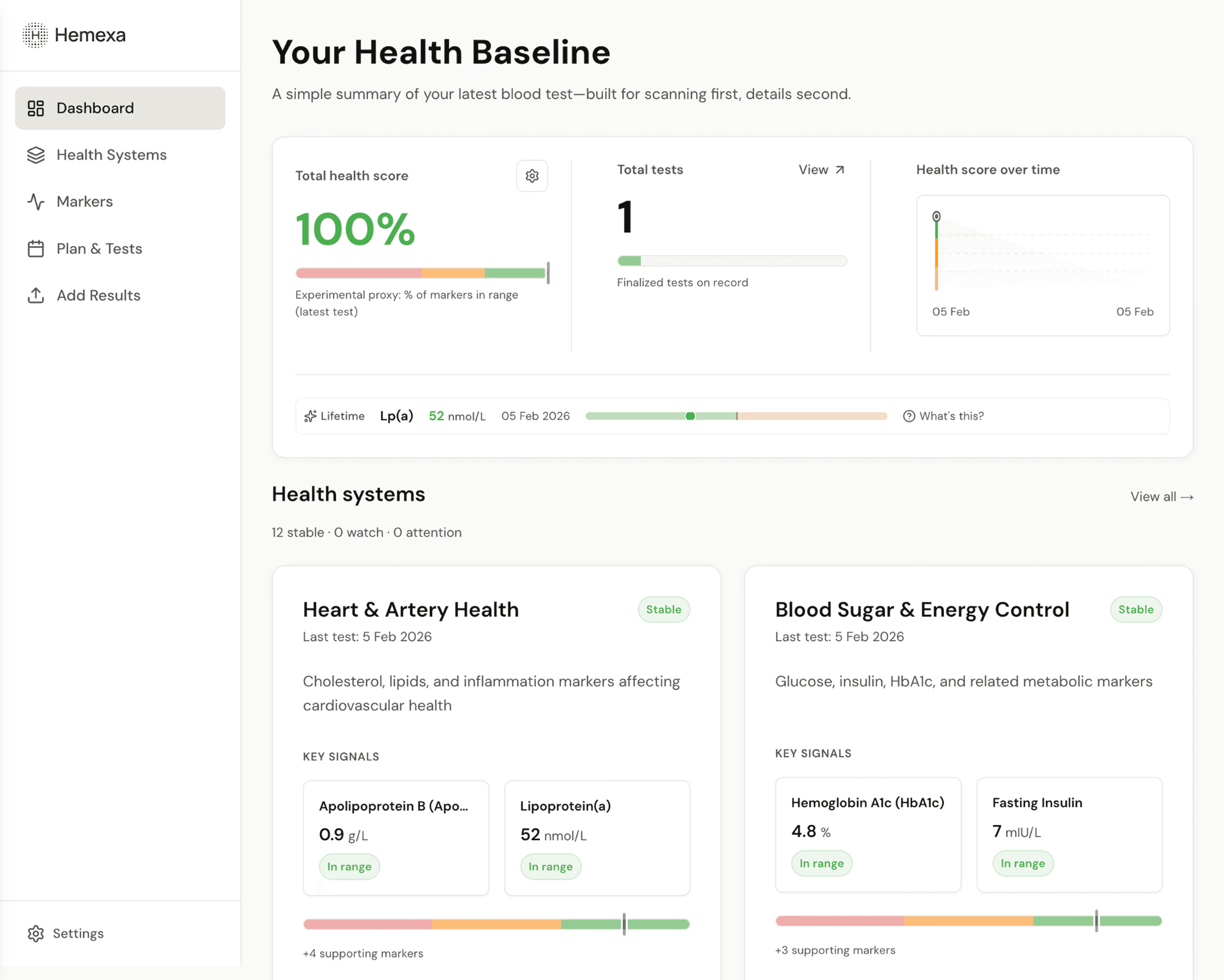
Hemexa includes Apolipoprotein B on the annual signature panel with LDL, Lp(a), hs-CRP, homocysteine, and related heart markers. Results feed into health-system scores and trend lines after each structured retest.
Hemexa includes Apolipoprotein B on the annual baseline panel as part of 76–80 signature markers across heart and circulation markers. You get ApoB with LDL, HDL, triglycerides, Lp(a), and hs-CRP in one coordinated draw.
ApoB is a slower-moving lipid marker, so it is measured once a year on your baseline rather than on the default six-month recheck, which focuses on faster-moving metabolic and inflammatory markers. If your baseline results and health plan point that way, ApoB can be brought forward onto your recheck in place of a default marker of comparable cost. Year-over-year results show whether diet, training, or medication changes are shifting ApoB in the right direction.
ApoB feeds into the heart and circulation health-system score on the Hemexa dashboard, with per-marker trend lines after each annual panel.
Hemexa coordinates authorised pathology requests and collection at 2,000+ centres nationwide through Healius Pathology, our only collection partner. No ad-hoc lab shopping or separate ApoB add-on fees.
Want the full preventative picture? Read our preventative blood test guide or blood test tracker guide.
Start your membership in the member app. Or browse all 76–80 markers before you decide.