
Silent shifts are common
Hypothyroidism and subclinical thyroid disease affect a meaningful share of adults, especially women. TSH can drift outside the optimal range years before classic symptoms are obvious.
Educational only; not medical advice
Thyroid blood tests measure hormones that control metabolic rate, energy, temperature regulation, mood, and heart rhythm. The usual starting point is TSH (thyroid-stimulating hormone). Free T4 and free T3 add detail when TSH is abnormal or symptoms persist. In Australia, TSH is often Medicare-funded when clinically indicated, while broader thyroid panels for asymptomatic preventative screening are commonly paid privately or bundled in comprehensive memberships.
Hemexa includes TSH, free T4, and free T3 on the annual signature panel with thyroid health-system tracking. This guide explains what each thyroid test measures, how to order in Australia, and how to interpret results with your clinician.
Your annual baseline includes 77+ signature markers (77 for men, 81 for women), including 13 calculated insights from your lab results. Measured draws depend on sex (64–68). Fast-moving markers are tested again on your included six-month retest.
Thyroid disorders are common in Australia and often develop slowly. Blood tests catch underactive or overactive thyroid before symptoms become severe, and establish baselines for people with family history, autoimmune risk, or unexplained fatigue and weight change.
Hypothyroidism and subclinical thyroid disease affect a meaningful share of adults, especially women. TSH can drift outside the optimal range years before classic symptoms are obvious.
Fatigue, brain fog, weight change, hair thinning, and feeling cold or hot can reflect thyroid, iron, sleep, or metabolic issues. Thyroid labs help narrow the picture alongside ferritin, glucose, and lipids.
If you take levothyroxine or other thyroid medication, periodic TSH and free T4 testing confirms dose. Preventative baselines before medication also help interpret future changes.
Australian pathology labs run standard thyroid assays. Knowing what each marker does prevents over-ordering or under-testing when symptoms do not match a TSH-only screen.
| Marker | What it measures | Medicare | Best for |
|---|---|---|---|
| TSH (thyroid-stimulating hormone) | Pituitary signal telling the thyroid how much hormone to make | Often funded when clinically indicated | First-line thyroid screen and medication monitoring |
| Free T4 (thyroxine) | Active circulating thyroid hormone produced by the thyroid gland | Usually funded with abnormal TSH or symptoms | Confirming hypothyroidism or hyperthyroidism after TSH |
| Free T3 (triiodothyronine) | More active thyroid hormone; some is converted from T4 in tissues | Less often funded for routine screening | Persistent symptoms with borderline TSH/T4, hyperthyroid workup; modest incremental value as a standalone routine screen over TSH and free T4 alone |
| TPO antibodies (anti-TPO) | Autoimmune activity against thyroid tissue (Hashimoto pattern) | Sometimes funded when autoimmune thyroid disease suspected | Family history of thyroid autoimmunity, goitre, or fluctuating TSH |
| Thyroglobulin antibodies (TgAb) | Second autoimmune marker; used with TPO in some cases | Usually private unless clinically indicated | Completing autoimmune picture when TPO is negative but suspicion remains |
Thyroid tests are routine NATA-accredited assays at Laverty, 4Cyte, Sullivan Nicolaides, Australian Clinical Labs, QML, and other networks. The practical question is what your GP will bill to Medicare versus what you pay privately.
A GP can usually request TSH under Medicare when symptoms, examination findings, pregnancy planning, medication monitoring, or family history support it. Broad "wellness" thyroid panels without clinical indication are often private.
A standalone private TSH may cost $20 to $50 out of pocket. TSH plus free T4 and free T3 as a private panel often runs $60 to $150. Antibody add-ons are extra. Comprehensive memberships bundle thyroid markers with metabolic and nutrient tests.
TSH has minor diurnal variation; morning draws are conventional. High-dose biotin supplements (common in hair and nail products) can falsely skew some immunoassay thyroid results. Pause high-dose biotin for 48 to 72 hours before testing if your clinician agrees.
Thyroid testing is appropriate when symptoms, family history, pregnancy, or medication monitoring warrant it. A preventative baseline while healthy is also common in comprehensive panels. Discuss with your GP or endocrinologist.
Persistent tiredness, unexplained weight gain or loss, feeling unusually cold or hot, dry skin, hair thinning, or palpitations warrant TSH at minimum, often with free T4.
Parents or siblings with Hashimoto thyroiditis, Graves disease, or goitre increase your risk. A baseline TSH and antibody panel can clarify inherited autoimmune tendency.
Thyroid function affects fertility and fetal development. Australian guidelines emphasise TSH monitoring in pregnancy and for women trying to conceive, with trimester-specific targets.
Treated hypothyroidism or hyperthyroidism needs periodic TSH (and sometimes free T4) to confirm dose. Retest 6 to 8 weeks after any dose change.
Many Australians include TSH, free T4, and free T3 in a comprehensive preventative panel to establish a reference point before symptoms appear, especially women in their 30s and 40s.
Other autoimmune conditions, neck radiation history, or iodine excess or deficiency can affect thyroid function. TPO antibodies help identify Hashimoto pattern when TSH is borderline.
From a Medicare TSH screen to a comprehensive membership that includes TSH, free T4, and free T3 on every annual panel. Costs and depth vary.
| Approach | Best for | Typical cost | Thyroid panel included? |
|---|---|---|---|
| GP TSH screen (Medicare) | Symptoms, pregnancy planning, or medication monitoring | Bulk-billed or low gap when clinically indicated | Usually TSH only; free T4 if TSH abnormal |
| GP-ordered thyroid panel (private) | TSH plus free T4/T3 when your doctor agrees | ~$60 to $150 out of pocket | TSH, free T4, sometimes free T3 and antibodies |
| Pay-per-panel services (e.g. MediTests, i-screen) | One-off thyroid or comprehensive metabolic panels | ~$50 to $300+ depending on panel | Often TSH with free T4/T3 in thyroid or wellness panels |
| Membership platforms (e.g. Hemexa) | Annual TSH, free T4, and free T3 baseline with trend tracking | ~$1,199/year (full membership) | Yes; TSH, free T4, and free T3 on annual panel among 77+ signature markers |
Australian labs report TSH in mIU/L and free T4/T3 in pmol/L with age- and lab-specific reference ranges. Interpretation should always involve your clinician. These are general reference points, not personal medical advice.
Many adult reference intervals are roughly 0.4 to 4.0 mIU/L, though optimal targets for wellbeing are sometimes discussed in a narrower band (for example 0.5 to 2.5 mIU/L). Pregnancy uses trimester-specific ranges.
Elevated TSH with low free T4 suggests overt hypothyroidism. High TSH with normal free T4 is subclinical hypothyroidism. Your GP or endocrinologist decides whether treatment is needed based on symptoms, antibodies, and repeat testing.
Suppressed TSH with high free T4 or free T3 suggests hyperthyroidism. Low TSH on thyroid medication can mean dose is too high. Context matters: illness, pregnancy, and pituitary conditions also affect results.
Thyroid hormones shift with illness, pregnancy, medication changes, and iodine intake. A single panel is useful; annual baselines and retests after dose changes show whether you are stable.
Thyroid labs reflect gland function, pituitary signalling, autoimmunity, and sometimes assay interference. These factors help you and your clinician interpret results and plan retesting.
TSH is highest overnight and lower in the afternoon. Acute illness can temporarily suppress TSH. Repeat testing when well, ideally in the morning, if results are unexpected.
Levothyroxine, antithyroid drugs, amiodarone, lithium, and high-dose biotin affect results. Take levothyroxine consistently and discuss timing of blood draws with your prescriber (often before the morning dose).
hCG stimulates the thyroid in early pregnancy, lowering TSH. Oestrogen raises binding proteins, which is why free T4 and free T3 are preferred over total hormone measurements.
Both iodine deficiency and excess can disrupt thyroid function. This matters for people on high-iodine supplements or very restrictive diets. Selenium and iron status also interact with thyroid hormone production.
TSH is the standard Australian screen. If symptoms persist with normal TSH, ask about free T4, free T3, and TPO antibodies.
Morning collection is conventional for TSH consistency. Fast only if other markers on the same request require it.
Biotin above 5 mg/day (common in hair supplements) can interfere with streptavidin-biotin immunoassays used by many thyroid tests. Discuss a 48 to 72 hour pause with your clinician.
Labs report mIU/L and pmol/L with local intervals. Do not compare raw numbers to US ng/dL cut-offs without conversion.
Pregnancy reference ranges differ. Trimester-specific interpretation prevents unnecessary treatment or missed hypothyroidism.
After starting or adjusting levothyroxine, retest TSH at 6 to 8 weeks. Annual monitoring is typical once stable. Hemexa includes thyroid markers on the annual panel for baseline tracking.
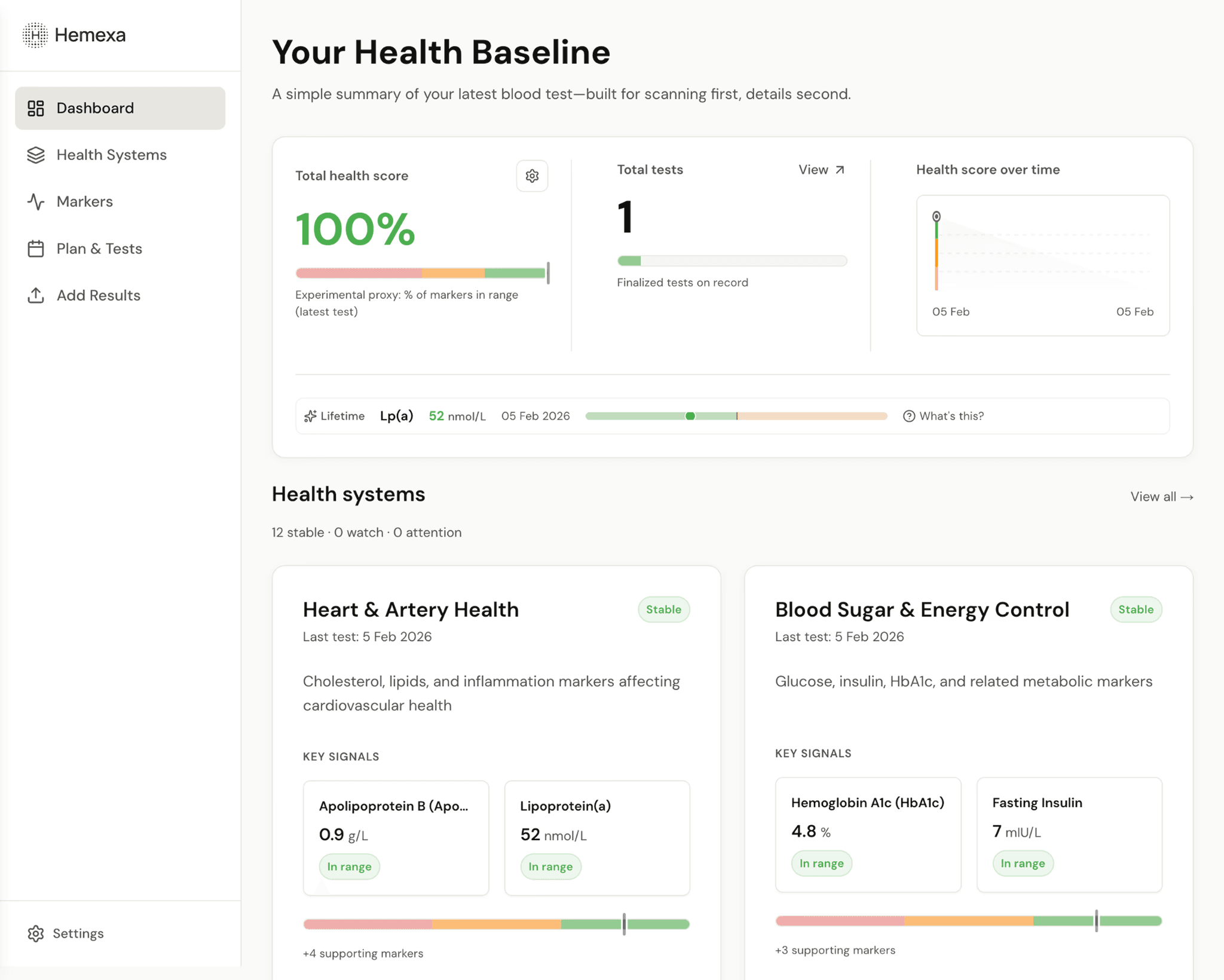
Hemexa includes TSH, free T4, and free T3 on the annual signature panel alongside ferritin, metabolic markers, and lipids. Results feed into the thyroid health-system dashboard.
Hemexa includes a full thyroid hormone panel on the annual baseline as part of 77+ signature markers in the thyroid health-system category. Free T3 is included for completeness and to help catch subtle dysfunction, though as a standalone routine screen its incremental value over TSH and free T4 alone is modest.
Results feed into the thyroid dashboard tile with per-marker context alongside metabolic markers that interact with thyroid function (glucose, ferritin, lipids).
TPO and thyroglobulin antibodies are available as clinical add-ons when autoimmune thyroid disease is suspected. Your GP can request these alongside membership pathology.
Hemexa coordinates authorised pathology requests and nationwide collection through Laverty. No ad-hoc lab shopping for thyroid add-ons.
See how thyroid fits into broader testing in our preventative blood test guide or biomarker testing guide.
Start your membership in the member app. Or browse all 77+ markers before you decide.