
Baselines beat guessing
Without a comprehensive baseline, you cannot tell whether a later result is new or a slow drift. Preventative testing creates that starting line while you feel well.
Educational only; not medical advice
A preventative blood test is a pathology panel ordered before symptoms appear, to establish a baseline and catch early shifts in metabolism, nutrients, hormones, inflammation, and organ function. In Australia, standard Medicare-funded tests are symptom-driven. Broader preventative panels are usually private: you pay out of pocket through a GP, a direct-to-consumer service, or a membership platform that coordinates testing and retesting.
Hemexa is a membership for Australians who want a coordinated preventative panel, an included six-month retest, and a health-system dashboard, not a one-off PDF. This guide explains how preventative testing works locally so you can choose the right path.
Your annual baseline includes 77+ signature markers (77 for men, 81 for women), including 13 calculated insights from your lab results. Measured draws depend on sex (64–68). Fast-moving markers are tested again on your included six-month retest.
Most Australians only get blood work when something feels wrong or a GP orders routine screening at a check-up. Preventative panels go wider: they map how your body is running today so you have a reference point for the future.
Without a comprehensive baseline, you cannot tell whether a later result is new or a slow drift. Preventative testing creates that starting line while you feel well.
Medicare funds clinically indicated tests. It does not routinely cover broad longevity, hormone optimisation, or nutrient panels for asymptomatic adults. Private preventative testing fills that gap.
Diet, training, sleep, and supplements affect blood markers over months. A structured panel plus retesting shows whether your changes are working, not just how you feel.
Australian pathology is NATA-accredited and delivered through large networks. Preventative panels still require a valid request pathway; the difference is who coordinates the panel and who pays.
Every blood test in Australia needs an authorised request. Reputable preventative services route orders through a registered GP who reviews clinical appropriateness. Avoid services that skip medical oversight.
Standard GP bloods billed to Medicare cover essentials when clinically indicated. Private preventative panels (often 40 to 100+ markers) are paid by you. Expect roughly $200 to $800+ per comprehensive panel depending on scope and provider.
Blood is collected at a pathology centre (Laverty, 4Cyte, Sullivan Nicolaides, Australian Clinical Labs, QML, and others). Most panels return within 24 to 72 hours. Fasting is required for glucose, lipids, and some metabolic markers.
Medicare screening, pay-per-panel services, and membership platforms each suit different goals. The right choice depends on how wide a panel you want and whether you need built-in retesting and tracking.
| Approach | Best for | Typical cost | Limitations |
|---|---|---|---|
| GP annual check-up (Medicare) | Standard screening when clinically indicated | Bulk-billed or low gap | Narrow marker set; not designed for broad preventative or longevity panels |
| Pay-per-panel services (e.g. MediTests, i-screen) | One-off comprehensive panels without ongoing membership | ~$150 to $500+ per panel | You coordinate each test and retest yourself; limited trend intelligence unless you use a separate tracker |
| Membership platforms (e.g. Hemexa, Vively, Everlab) | Structured annual panel plus included retest and dashboard | ~$1,199+/year | Annual commitment; panels follow the provider program rather than ad-hoc GP orders |
Panels vary by provider. These groups cover what most Australians look for in a comprehensive preventative baseline. Your clinician may add or remove markers based on age, sex, medications, and family history.
Fasting glucose, HbA1c, insulin (where available), total and HDL cholesterol, triglycerides, and sometimes ApoB or Lp(a). These markers shift with diet, weight, and training.
ALT, AST, GGT, bilirubin, creatinine, eGFR, and electrolytes. Useful baselines before supplements, medications, or high-protein diets.
TSH is the usual screen; free T4 and free T3 add depth when symptoms or family history warrant it. Thyroid affects energy, weight, and mood.
Ferritin, iron studies, vitamin D, and B12 are common preventative additions. Deficiency is common in Australia and often asymptomatic early on.
hs-CRP and full blood count (FBC) give context on systemic inflammation and blood cell health.
Testosterone, oestradiol, SHBG, and related markers for men and women at different life stages. Timing and cycling matter for interpretation.
Australian law requires authorised pathology requests. A legitimate preventative service includes GP oversight, not anonymous online ordering without clinical review.
Labs should report age- and sex-specific ranges aligned with RCPA guidance. US-imported panels may use different cut-offs.
Confirm whether you need 8 to 12 hours fasting and whether morning collection is required for cortisol or hormone timing.
A single panel is a snapshot. Metabolic and lipid markers often benefit from a six-month follow-up. Ask whether retesting is included or priced separately.
PDFs in email do not compare year on year. Prefer providers that chart the same markers over time or pair testing with a tracker.
Count markers explicitly. "Comprehensive" means different things across providers. Sex-specific markers change total counts.
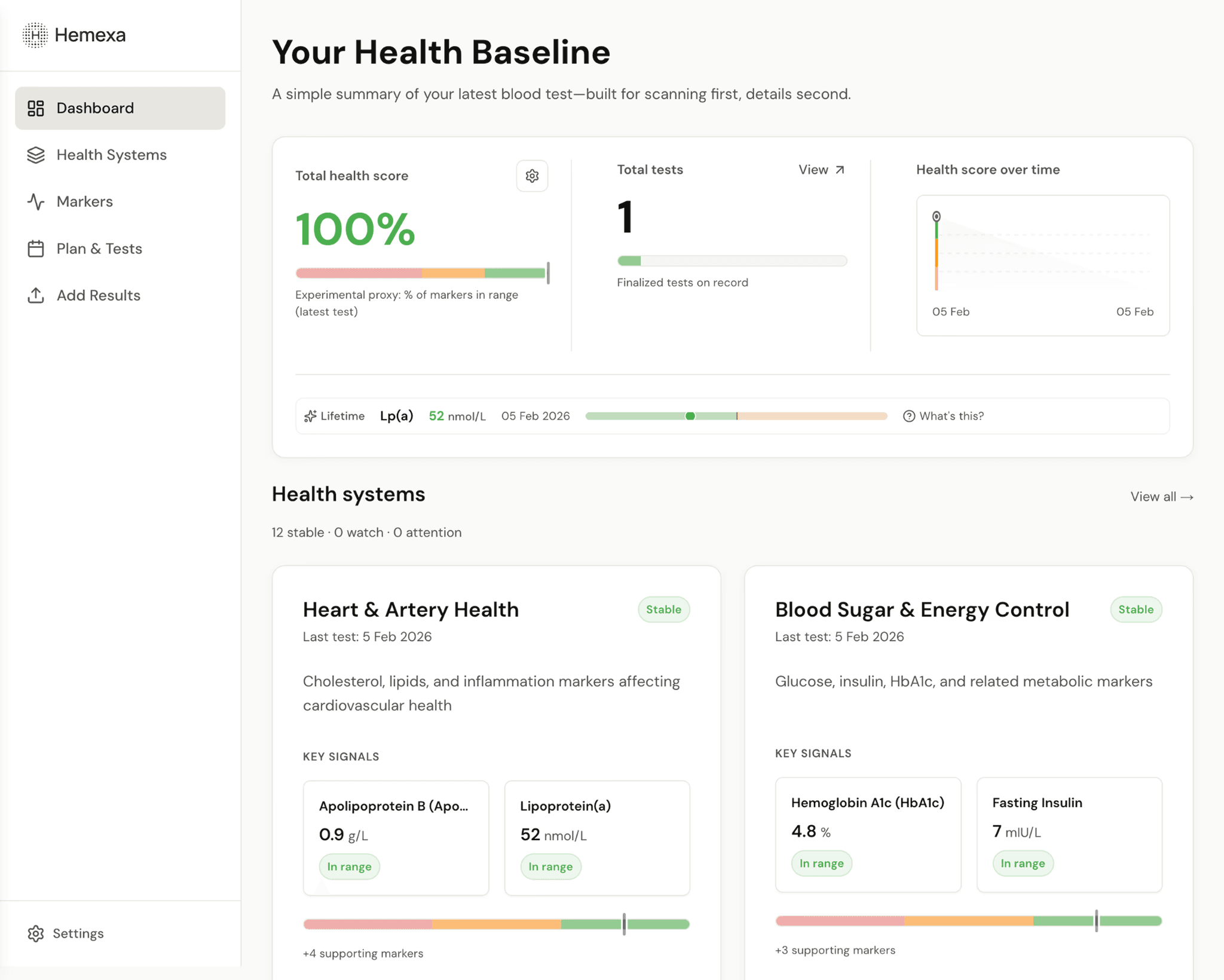
Hemexa coordinates GP-reviewed requests, Laverty collection, structured panels, and a dashboard that turns results into health-system scores, trends, and a personalised plan.
Membership includes a full annual preventative panel and an included six-month retest on markers that move fastest. 77+ signature markers on baseline; a small number are sex-specific.
Hemexa coordinates authorised pathology requests and nationwide collection through the Laverty network. You book collection after your request is approved.
Results roll into health-system scores (heart, metabolism, thyroid, hormones, nutrients, and more) with per-marker trends after each structured panel.
Each test generates plain-language sections on what changed and what to discuss with your clinician, so testing leads to action.
Already have results and want to track them? Read our blood test tracker guide.
Start your membership in the member app. Or browse all 77+ markers before you decide.