
Healthspan, not just lifespan
Longevity testing focuses on how well your body is running today: insulin sensitivity, lipids, inflammation, thyroid, iron, vitamins, and hormones. The goal is to catch drift early while you still feel fine.
Educational only; not medical advice
A longevity blood test is a broad pathology panel ordered to measure how your body is ageing at a biochemical level: metabolism, cardiovascular risk, inflammation, hormones, nutrients, and organ function before symptoms appear. In Australia, these panels are almost always private. They go wider than standard Medicare-funded GP screening and are designed for repeat testing so you can track healthspan over years, not just react to illness.
This guide explains what longevity panels include, how Australian options compare to US services like Function Health, and what to look for when you choose between one-off tests, longevity clinics, and membership platforms like Hemexa.
Your annual baseline includes 77+ signature markers (77 for men, 81 for women), including 13 calculated insights from your lab results. Measured draws depend on sex (64–68). Fast-moving markers are tested again on your included six-month retest.
Interest in longevity testing has grown as US services like Function Health popularised large annual panels. Australians searching for the same idea want local pathology, GP oversight, and results they can retest and compare over time.
Longevity testing focuses on how well your body is running today: insulin sensitivity, lipids, inflammation, thyroid, iron, vitamins, and hormones. The goal is to catch drift early while you still feel fine.
Standard GP bloods under Medicare are symptom-driven and narrower. A longevity panel is typically 40 to 100+ markers paid out of pocket, requested through a GP or a coordinated preventative service.
Longevity programs assume retesting. Metabolic and lipid markers can shift within six months after diet, training, or supplement changes. Annual plus mid-year retests are common in membership models.
Both use the same NATA-accredited Australian pathology labs. The difference is scope, who pays, and whether results are tracked longitudinally.
A standard Medicare check-up might include FBC, lipids, glucose, liver function, and thyroid screen when clinically indicated. Longevity panels add insulin, ApoB or advanced lipids where available, hs-CRP, ferritin, vitamin D, B12, sex hormones, and more depending on age and sex.
Every Australian blood test needs an authorised pathology request. Legitimate longevity services route orders through a registered GP. Avoid services that promise testing without proper clinical oversight.
A PDF alone does not build a longevity program. Clinics may pair results with doctor consults; platforms chart trends and health-system scores; pay-per-panel services leave interpretation to you and your GP unless you add a tracker.
There is no single "longevity blood test" product registered in Australia. Instead, several models deliver broad preventative panels with different levels of coaching, retesting, and dashboard intelligence.
Services like MediTests and i-screen sell comprehensive panels without annual membership. You pay per draw, take the request to a local pathology centre, and receive a PDF. Good for a one-off baseline; you coordinate retests yourself.
Clinics such as Everlab pair blood panels with doctor-led programs, imaging at higher tiers, and in-person or telehealth consults. Essentials-tier pricing often starts around $799/year with a clinic-led model.
Hemexa, Vively, and similar products bundle GP-reviewed requests, defined panels, retesting, and a member dashboard. Hemexa is AU$1,199/year with 77+ signature markers on baseline with an included six-month retest (90+ marker results in year one), and health-system trend charts.
Function Health and other US subscription panels are not available to Australian residents with local collection and Medicare context. Australians compare local alternatives with Australian reference ranges and pathology networks.
Searching for Function Health in Australia? See our Function Health Australia guide for local alternatives.
No universal longevity panel exists. These marker groups appear most often in Australian preventative and longevity programs. Your clinician may add or remove tests based on age, sex, and history.
Fasting glucose, HbA1c, and fasting insulin are core longevity markers. They reveal drift toward insulin resistance years before type 2 diabetes is diagnosed.
Total cholesterol, HDL, triglycerides, and LDL are standard. Longevity-focused panels often add ApoB and sometimes Lp(a) for a clearer picture of atherosclerotic risk.
High-sensitivity CRP (hs-CRP) tracks low-grade systemic inflammation linked to cardiovascular and metabolic ageing. Interpret alongside acute illness; retest when well.
TSH is the usual screen. Free T4 and free T3 add depth when energy, weight, or temperature regulation are concerns. Thyroid affects metabolic rate across the lifespan.
Vitamin D, B12, and ferritin are common longevity additions. Deficiency is frequent in Australia and often asymptomatic in early stages.
LFTs, creatinine, eGFR, and full blood count establish organ and immune baselines before supplements, medications, or training blocks.
Testosterone, SHBG, oestradiol, and related markers for men and women at different life stages. Timing, cycling, and life stage matter for interpretation; discuss with your clinician.
Price and marker count vary. The bigger decision is whether you want a one-off panel, a doctor-led clinic program, or a platform that bundles testing, retesting, and trend tracking.
| Approach | Best for | Typical cost | Limitations |
|---|---|---|---|
| GP-led private panel | Custom marker list with your own doctor | ~$200 to $600+ per panel | You source retests and tracking; marker list varies by GP familiarity with longevity testing |
| Pay-per-panel (e.g. MediTests, i-screen) | One-off comprehensive baseline without membership | ~$150 to $500+ per panel | No included retest or trend dashboard; each follow-up is another purchase |
| Longevity clinic (e.g. Everlab) | Doctor-led longevity program with consults | From ~$799/yr (Essentials) to $2,000+/yr | Higher tiers add imaging and intensive coaching; panel scope follows clinic program |
| Platform membership (e.g. Hemexa, Vively) | Structured panel, retest, and dashboard in one annual fee | ~$1,199+/year | Annual commitment; philosophy differs (blood intelligence vs CGM-led metabolic coaching) |
RCPA-aligned ranges differ from US lab defaults. A longevity panel should report against Australian norms, not imported US cut-offs.
Pathology in Australia requires authorised requests. Reputable longevity services include registered GP oversight, not anonymous online ordering.
"Comprehensive" means different things across providers. Ask how many markers are included and which are sex-specific (hormones, PSA, etc.).
Glucose, insulin, and lipids usually need 8 to 12 hours fasting. Some hormone tests need morning collection. Follow instructions or results may be misleading.
Longevity is longitudinal. Ask whether a six-month metabolic retest is bundled or costs extra. Hemexa includes a six-month retest on fast-moving markers.
Compare the same markers over time in charts or health-system scores. Upload apps and memberships handle this differently; PDFs in email do not.
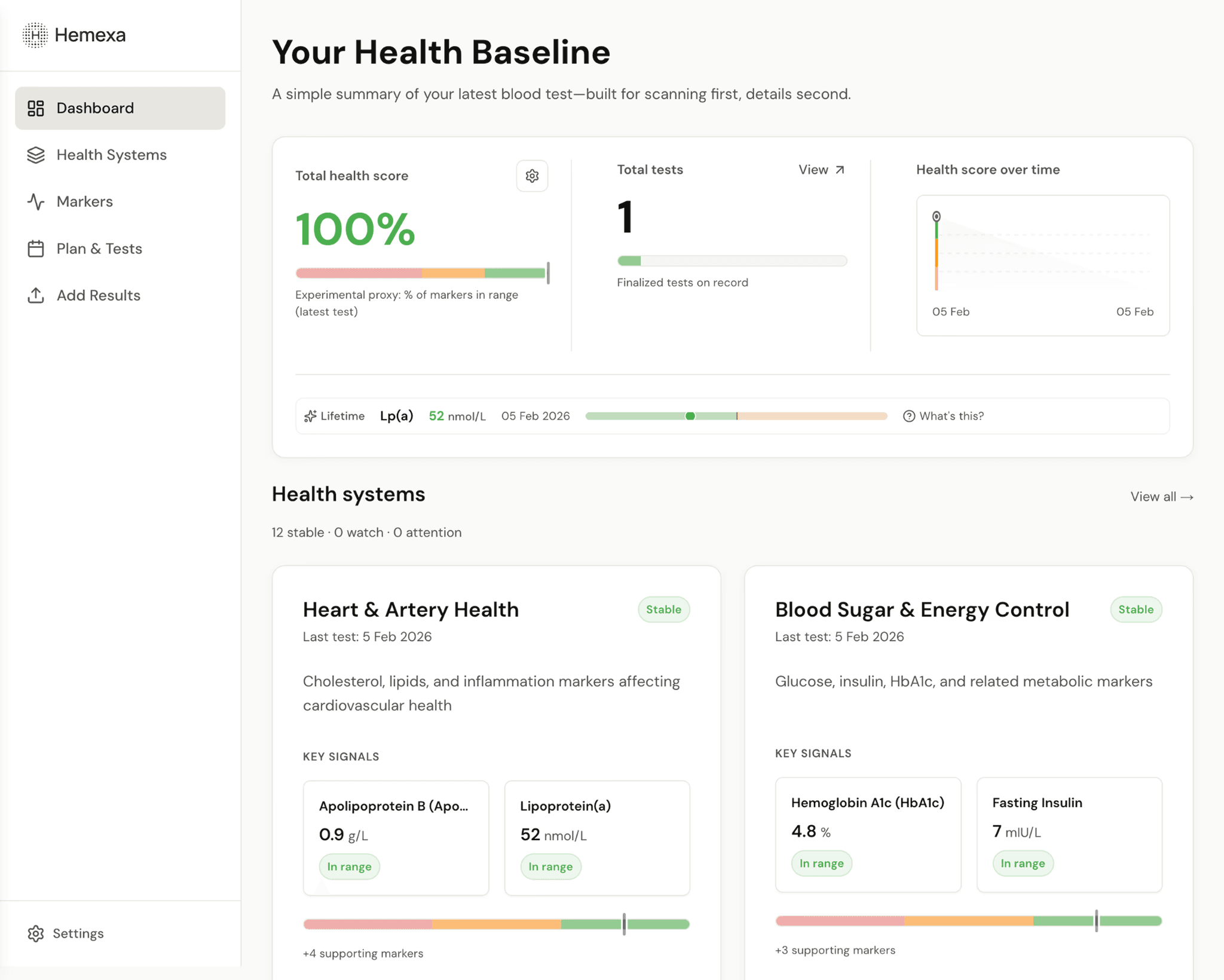
Hemexa is a platform membership, not a longevity clinic. It coordinates broad panels, charts trends across health systems, and includes a six-month retest so longevity testing stays longitudinal, not a one-off PDF.
Annual membership includes a full longevity-oriented baseline and an included six-month retest on markers that move fastest. 77+ signature markers; a small number are sex-specific.
Results map to heart, metabolism, thyroid, hormones, nutrients, inflammation, and more, with per-marker trend lines after each structured panel.
Hemexa coordinates authorised pathology requests and nationwide blood collection through the Laverty network.
Each panel generates plain-language sections on what changed plus supplement guidance linked to your blood, for discussion with your own clinician.
Start your membership in the member app. Or browse all 77+ markers before you decide.