
Inflammation drives arterial disease
Atherosclerosis is an inflammatory process. Elevated hs-CRP reflects active vascular inflammation and predicts heart attack and stroke risk independently of cholesterol in large population studies.
Educational only; not medical advice
High-sensitivity C-reactive protein (hs-CRP) is a blood test measuring low-grade systemic inflammation. The liver produces CRP in response to inflammation; the high-sensitivity assay detects smaller rises than a standard CRP test. In Australia, hs-CRP is used in cardiovascular risk assessment and preventative health panels. It is usually included in private comprehensive blood tests and may be Medicare-funded when ordered for specific clinical reasons, but not routinely for asymptomatic screening alone.
Hemexa includes high-sensitivity CRP on the annual baseline and six-month retest with inflammation trend tracking. This guide explains what hs-CRP measures, when to test while well, how to order in Australia, and how to interpret results with your clinician.
Your annual baseline includes 77+ signature markers (77 for men, 81 for women), including 13 calculated insights from your lab results. Measured draws depend on sex (64–68). Fast-moving markers are tested again on your included six-month retest.
Chronic low-grade inflammation sits behind much of cardiovascular and metabolic disease. hs-CRP captures that signal when you are otherwise well. It adds context that lipids alone cannot provide.
Atherosclerosis is an inflammatory process. Elevated hs-CRP reflects active vascular inflammation and predicts heart attack and stroke risk independently of cholesterol in large population studies.
Some people have acceptable LDL but elevated hs-CRP. That pattern suggests inflammatory cardiovascular risk that standard lipid panels miss. Pairing hs-CRP with ApoB and LDL gives a fuller picture.
Unlike genetically fixed markers such as Lp(a), hs-CRP moves with weight loss, training, sleep, smoking cessation, and anti-inflammatory lifestyle changes. That makes it worth tracking over time.
Both measure C-reactive protein, but they answer different clinical questions. Confusing them leads to misinterpretation, especially during illness.
| Marker | What it measures | Medicare | Best for |
|---|---|---|---|
| hs-CRP (high-sensitivity) | Low-grade systemic inflammation in mg/L | Sometimes funded with cardiovascular risk workup | Preventative risk assessment when well; tracking metabolic inflammation |
| CRP (standard) | Acute inflammation, often reported up to 10+ mg/L | Often funded when infection or inflammation suspected | Detecting bacterial infection, flare of autoimmune disease, post-surgery monitoring |
| ESR (erythrocyte sedimentation rate) | Rate red cells settle; indirect inflammation marker | Commonly funded with inflammatory workups | Broad inflammatory screening; slower to change than CRP |
| Ferritin (acute phase reactant) | Iron stores; also rises with inflammation | Often funded when clinically indicated | Iron status; interpret cautiously when hs-CRP is elevated |
hs-CRP is a standard NATA-accredited assay at major Australian pathology laboratories. The practical questions are when Medicare applies, how much a private add-on costs, and whether you are well enough for a meaningful result.
Medicare may fund CRP or cardiovascular risk tests when clinically warranted. Standalone hs-CRP for asymptomatic preventative screening is often an out-of-pocket add-on, typically $25 to $60, or bundled in private heart health panels ($80 to $250+).
Pathology in Australia requires an authorised request from a registered medical practitioner. Reputable preventative services include GP clinical review before the lab order is issued.
Acute infection, injury, recent surgery, dental work, or intense training can temporarily raise CRP. For preventative interpretation, collect blood when you have been well for at least two weeks with no fever or active illness. For a reliable athlete baseline, allow at least 72 hours after a hard training session, and ideally about one week after a race or unaccustomed training block.
hs-CRP is not needed for everyone, but it adds an inflammatory dimension when lipids look fine or metabolic risk is unclear. Avoid testing during acute illness. Discuss with your GP or cardiologist.
Adults evaluating heart disease risk, especially when LDL or ApoB is borderline or family history is strong. hs-CRP adds an inflammatory dimension standard lipids miss.
Visceral fat and insulin resistance often raise hs-CRP before HbA1c climbs. Pairing hs-CRP with fasting glucose, insulin, and HOMA-IR clarifies metabolic inflammation.
If LDL is at target but risk feels high, elevated hs-CRP may indicate inflammatory residual risk worth discussing with your cardiologist.
hs-CRP helps monitor low-grade activity between flares when interpreted alongside symptoms and specialist care. Not a substitute for disease-specific monitoring.
Preventative programs use hs-CRP as a feedback marker for diet, training, sleep, and body composition changes over six to twelve months.
A baseline when well establishes your normal. Very intense unaccustomed exercise can transiently raise CRP; compare retests drawn under similar conditions.
From a GP cardiovascular workup with a private add-on to a comprehensive membership that includes hs-CRP on baseline and six-month retest. Costs and convenience vary.
| Approach | Best for | Typical cost | hs-CRP included? |
|---|---|---|---|
| GP cardiovascular risk assessment | Clinically indicated inflammation or heart risk workup | Bulk-billed or low gap when eligible | Sometimes; depends on GP and indication |
| GP-ordered hs-CRP add-on (private) | Targeted inflammation marker with GP oversight | ~$25 to $60 out of pocket | Yes, as a standalone or small add-on |
| Pay-per-panel services (e.g. MediTests, i-screen) | One-off heart health or comprehensive panels | ~$80 to $300+ depending on panel | Often included in advanced cardiovascular panels |
| Membership platforms (e.g. Hemexa) | Annual baseline plus six-month retest with trend tracking | ~$1,199/year (full membership) | Yes; hs-CRP on baseline and six-month retest among 77+ signature markers |
Australian labs report hs-CRP in mg/L with reference intervals on the report. Interpretation belongs with your clinician. These are common reference points used in preventative medicine, not personal medical advice.
Many Australian labs flag hs-CRP below 3.0 mg/L as within reference range for the general population. That upper limit is a population cut-off, not necessarily an optimal preventative target.
Broad risk framing used in cardiology: below 1.0 mg/L suggests lower relative risk, 1.0 to 3.0 mg/L average, above 3.0 mg/L higher relative risk. Optimal preventative targets for some adults are below 1.0 mg/L when other risk factors are present.
hs-CRP above 10 mg/L often reflects acute infection or significant inflammation, not chronic cardiovascular risk. Retest after recovery. Do not make long-term decisions on a result drawn during illness.
A single hard workout can temporarily raise CRP. For a reliable athlete baseline, allow at least 72 hours after a hard training session, and ideally about one week after a race or unaccustomed training block. Illness and exercise timing are separate: avoid testing when acutely unwell even if you are recovered from training.
A single hs-CRP is a snapshot. Weight loss, improved sleep, and training can lower hs-CRP over months. Hemexa retests hs-CRP on the six-month panel alongside glucose, lipids, and insulin.
hs-CRP reflects modifiable and non-modifiable factors. These are common levers clinicians discuss after results, not substitutes for personalised medical advice.
Visceral adiposity and insulin resistance are among the strongest drivers of elevated hs-CRP. Weight loss and improved glucose control often lower hs-CRP within 8 to 12 weeks.
Mediterranean-style eating patterns, higher fibre intake, and reduced ultra-processed food are associated with lower hs-CRP in trials. Omega-3 fatty acids may help in some people.
Regular moderate exercise and consistent sleep lower chronic inflammation markers over time. A single hard workout can temporarily raise CRP. For a reliable baseline, allow at least 72 hours after a hard session, and ideally about one week after a race or unaccustomed training block.
Smoking and chronic gum disease maintain low-grade systemic inflammation. Smoking cessation and dental care can lower hs-CRP independent of other changes.
Request high-sensitivity C-reactive protein (hs-CRP). Standard CRP assays are not sensitive enough for low-grade cardiovascular risk assessment.
Avoid testing during colds, flu, COVID, dental procedures, or major injury. For a reliable athlete baseline, allow at least 72 hours after a hard training session, and ideally about one week after a race or unaccustomed training block. Inflammation from acute events skews results.
hs-CRP does not require fasting. If drawn on the same tube as lipids or glucose, follow the fasting instructions on your lab slip.
hs-CRP is most informative alongside ApoB or LDL, triglycerides, fasting glucose, insulin, and HbA1c. Inflammation and lipids tell different parts of the same story.
Because hs-CRP responds to lifestyle, retest every six to twelve months when well, or eight to twelve weeks after a major intervention to confirm change.
Email results make it hard to see whether hs-CRP is improving. Use a tracker or membership dashboard that plots hs-CRP alongside lipids and glucose over time.
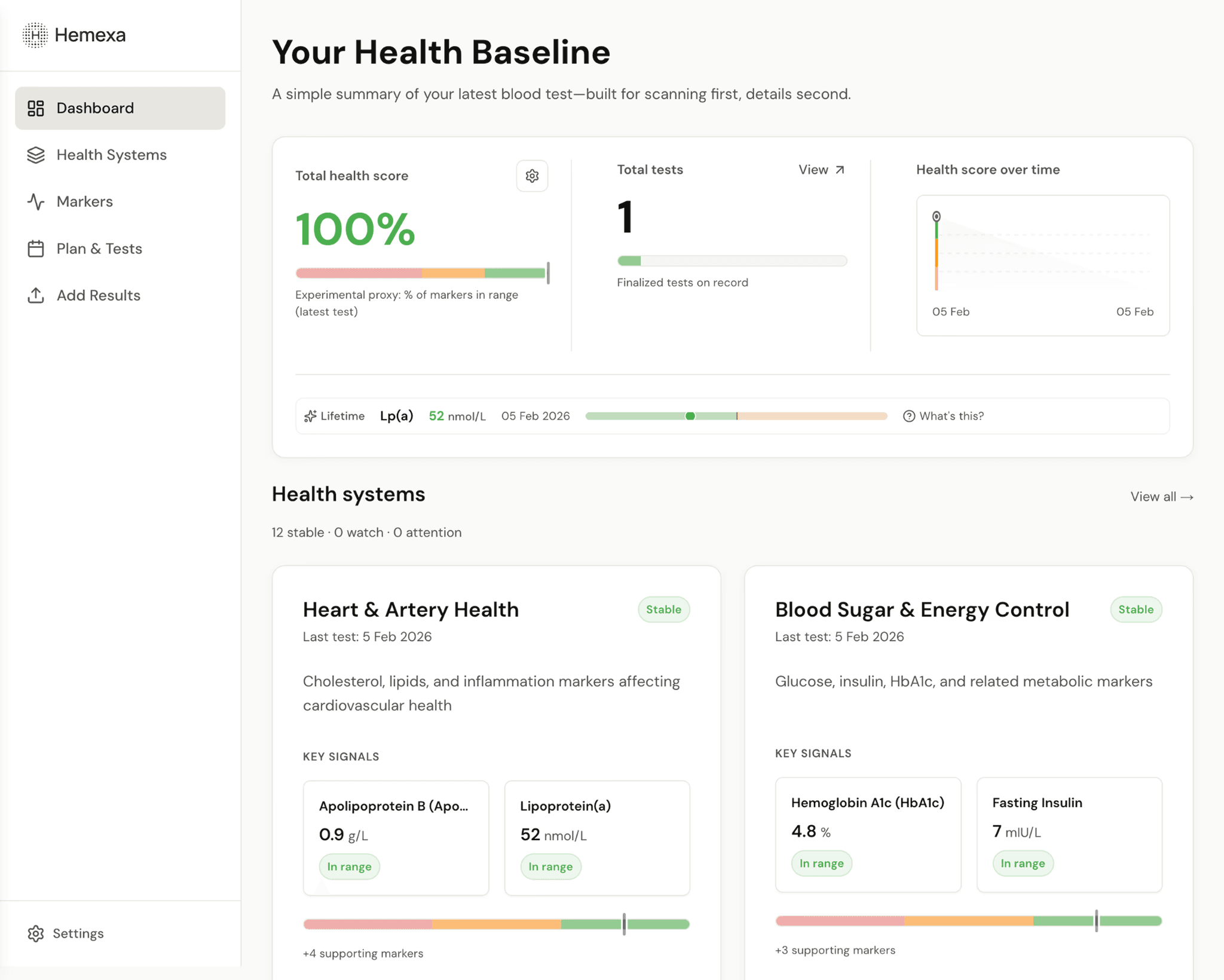
Hemexa includes high-sensitivity CRP on the annual baseline and six-month retest alongside ApoB, LDL, Lp(a), glucose, and insulin. Results feed into immune and heart health scores with trend lines after each structured panel.
Hemexa includes high-sensitivity CRP on the annual baseline panel and again on the included six-month retest as part of 77+ signature markers. Inflammation markers that move with lifestyle are retested on schedule.
hs-CRP feeds into immune function and heart health scores on the Hemexa dashboard, alongside ApoB, lipids, Lp(a), and full blood count markers for a complete inflammatory picture.
Elevated hs-CRP surfaces in your health plan with plain-language context on what changed and what to discuss with your clinician, including lifestyle levers and follow-up timing.
Hemexa coordinates authorised pathology requests and nationwide collection through Laverty. No separate hs-CRP add-on or ad-hoc lab shopping.
Pair inflammation with lipids. Read our ApoB test guide or preventative blood test guide.
Start your membership in the member app. Or browse all 77+ markers before you decide.