
Deficiency is often silent early on
Low vitamin D can develop without obvious symptoms until levels fall substantially. A blood test confirms whether you are deficient, insufficient, or replete before bone density, mood, or immune issues appear.
Educational only; not medical advice
A vitamin D blood test measures 25-hydroxyvitamin D (25-OH vitamin D), the main circulating storage form of vitamin D in your body. It reflects vitamin D from sun exposure, food, and supplements over the prior weeks. In Australia labs report results in nmol/L. The test is NATA-accredited and widely available, but Medicare only funds it when a GP judges it clinically necessary, so routine preventative screening is usually paid privately.
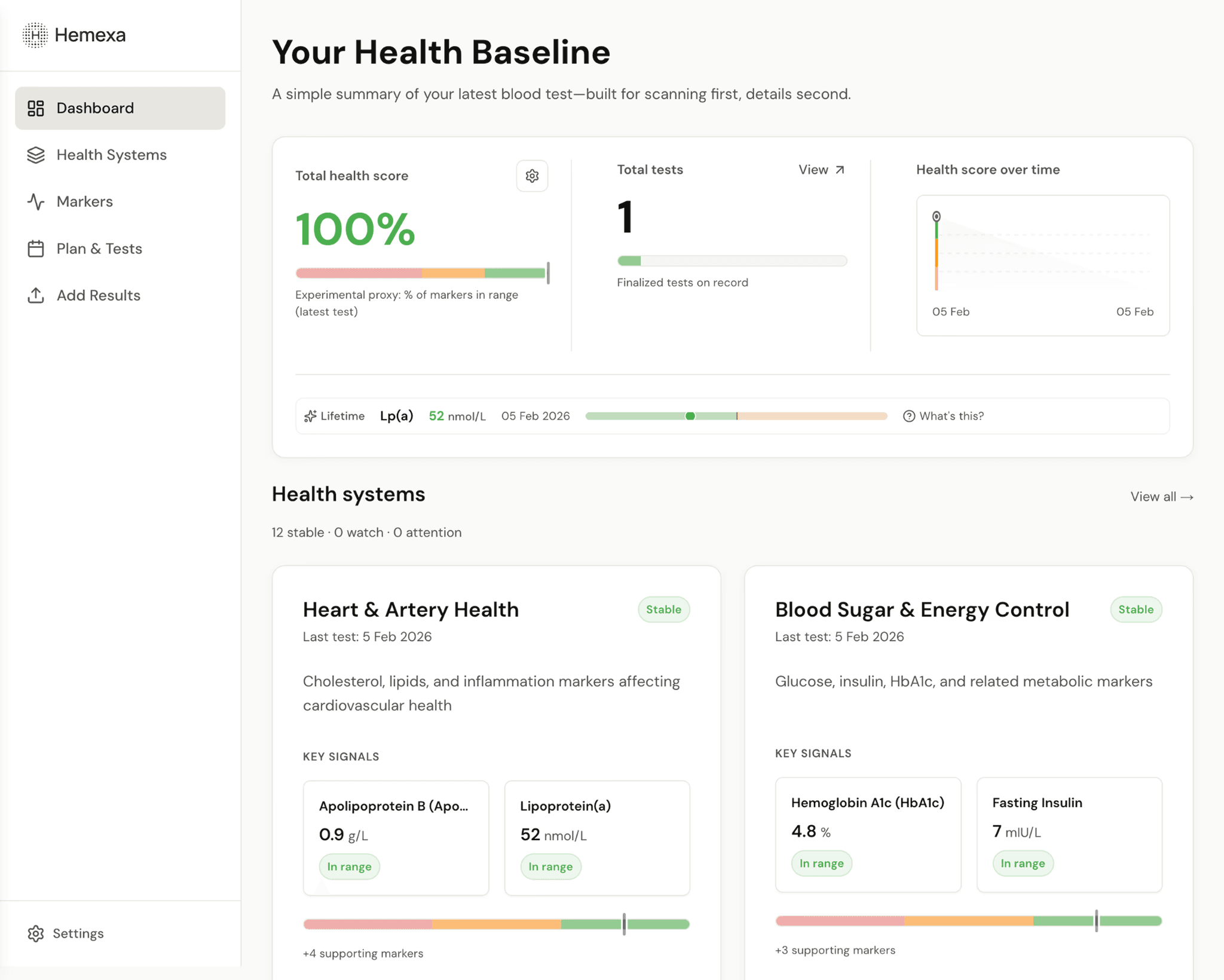
Hemexa includes 25-hydroxyvitamin D on the annual signature panel with supplement insights, an included six-month retest, and nutrient trend tracking. This guide explains what the test measures, how to order it in Australia, and how to interpret results with your clinician.
Your annual baseline includes 77+ signature markers (77 for men, 81 for women), including 13 calculated insights from your lab results. Measured draws depend on sex (64–68). Fast-moving markers are tested again on your included six-month retest.
Vitamin D supports bone health, immune function, and muscle strength. Deficiency is common in Australia despite abundant sunshine, because lifestyle, latitude, skin coverage, and sunscreen reduce effective sun exposure for many people.
Low vitamin D can develop without obvious symptoms until levels fall substantially. A blood test confirms whether you are deficient, insufficient, or replete before bone density, mood, or immune issues appear.
Office workers, people with darker skin, older adults, and those who cover skin for cultural or medical reasons often do not synthesise enough vitamin D from sun alone, even in sunny climates.
Many Australians take vitamin D without knowing their level. Testing before and after supplementation shows whether your dose is appropriate and avoids unnecessary high-dose loading.
When Australians ask for a "vitamin D blood test," they almost always mean 25-hydroxyvitamin D. Other vitamin D assays exist but serve different clinical purposes.
| Test | What it measures | Medicare | Best for |
|---|---|---|---|
| 25-hydroxyvitamin D (25-OH D) | Storage form of vitamin D from sun, food, and supplements | Funded when clinically indicated; routine screening usually private | Deficiency screening, monitoring supplementation, preventative baselines |
| 1,25-dihydroxyvitamin D (1,25-OH D) | Active hormonal form, tightly regulated by kidneys | Specialist-ordered for specific conditions | Kidney disease, calcium disorders, granulomatous disease (not routine screening) |
| Vitamin D2 vs D3 (separate assays) | Contribution from plant (D2) vs animal/sun (D3) sources | Rarely ordered separately in Australia | Research or specialist investigation, not standard care |
| Calcium and phosphate (paired tests) | Minerals regulated alongside vitamin D and parathyroid hormone | Often funded when clinically indicated | Bone health workups alongside 25-OH vitamin D |
Australian pathology labs standardise on nmol/L for 25-OH vitamin D. The practical questions are whether Medicare pays, who orders the test, and how to interpret results against local reference ranges.
Medicare may fund vitamin D testing when a GP documents clinical need, such as osteoporosis risk, malabsorption, chronic kidney disease, or specific symptoms. Broad preventative screening in asymptomatic adults is typically out of pocket, often $40 to $80 standalone.
Pathology in Australia requires an authorised request from a registered medical practitioner. Reputable direct-to-consumer services include GP clinical review before the lab order is issued.
25-OH vitamin D does not typically require fasting. It can be drawn at any time of day with a standard blood collection at Laverty, 4Cyte, Sullivan Nicolaides, Australian Clinical Labs, QML, or other pathology centres. Results usually return within 24 to 72 hours.
Vitamin D testing is common in bone health workups and increasingly in preventative nutrient panels. Discuss with your GP whether testing is appropriate for your situation.
Office workers, night-shift workers, and people who cover skin for cultural, religious, or medical reasons often have lower vitamin D despite living in Australia.
Higher melanin reduces vitamin D synthesis from the same sun exposure. People with darker skin may need more deliberate sun or supplementation to maintain adequate levels.
Skin becomes less efficient at producing vitamin D with age. Older Australians are at higher risk of deficiency and falls related to bone and muscle health.
Vitamin D works with calcium for bone mineralisation. Testing is common when investigating low bone density, fractures, or parathyroid hormone abnormalities.
Celiac disease, inflammatory bowel disease, and gastric bypass reduce vitamin D absorption. Monitoring is part of ongoing care.
Many Australians include 25-OH vitamin D in a comprehensive nutrient panel to establish a baseline before problems appear, especially alongside B12, ferritin, and folate.
From a Medicare-funded GP order when clinically indicated to a comprehensive membership that includes 25-OH vitamin D on every annual panel. Costs and convenience vary.
| Approach | Best for | Typical cost | Vitamin D included? |
|---|---|---|---|
| GP-ordered test (Medicare when indicated) | Testing when symptoms or risk factors justify clinical need | Bulk-billed or low gap if Medicare criteria met | Yes, when GP documents indication |
| GP-ordered private vitamin D test | Preventative check when Medicare does not apply | ~$40 to $80 out of pocket | Yes, standalone 25-OH vitamin D |
| Pay-per-panel services (e.g. MediTests, i-screen) | One-off nutrient or comprehensive panels | ~$80 to $300+ depending on panel | Usually included in nutrient or comprehensive panels |
| Membership platforms (e.g. Hemexa) | Annual vitamin D baseline with retest and trend tracking | ~$1,199/year (full membership) | Yes; 25-OH vitamin D on signature panel among 77+ signature markers |
Australian labs report 25-OH vitamin D in nmol/L with reference intervals that vary slightly by laboratory. Interpretation should always involve your clinician. These are general reference points, not personal medical advice.
Many Australian labs use roughly 50 to 150 nmol/L as an adult reference interval. Levels below 50 nmol/L are commonly classified as deficient. The Australian and New Zealand Bone and Mineral Society (ANZBMS) holds that 50 nmol/L and above is adequate for most people. The framing of 50 to 75 nmol/L as insufficient comes from the US Endocrine Society position, not ANZBMS. Some clinicians may target higher levels for specific goals; that is individual, not a blanket Australian guideline.
Australian results are in nmol/L. US labs often use ng/mL. To convert roughly: divide nmol/L by 2.5 to get ng/mL (e.g. 100 nmol/L is about 40 ng/mL). Do not compare your Australian result to US online cut-offs without converting.
Being inside the lab reference range does not always mean optimal for your goals. Athletes, people with autoimmune conditions, or those optimising bone density may target the upper half of the range with clinician guidance. Toxicity from vitamin D is uncommon but possible at very high sustained levels.
If you start or increase vitamin D supplementation, retest in 8 to 12 weeks to confirm levels are moving into target range. Annual monitoring is reasonable once stable.
Vitamin D reflects sun exposure, diet, body composition, supplements, and season. These are levers clinicians discuss after results, not substitutes for personalised medical advice.
Vitamin D rises in summer and falls in winter, especially in southern states. Brief midday sun on arms and legs can help, but balance skin cancer risk with your clinician.
Fatty fish, egg yolks, and fortified foods provide modest vitamin D. Diet alone rarely maintains optimal levels in deficient Australians without sun or supplements.
Vitamin D3 (cholecalciferol) is the usual supplement form. Typical maintenance doses range from 1,000 to 4,000 IU daily depending on baseline level and clinician advice. Retest after 8 to 12 weeks.
Vitamin D is fat-soluble and can be sequestered in adipose tissue. People with higher body fat may need higher doses to reach the same blood level.
Ask for 25-hydroxyvitamin D, not 1,25-dihydroxyvitamin D unless your specialist has a specific reason. The standard screening test is 25-OH D.
Australian labs report nmol/L. If comparing to past results from overseas or US labs, check whether those used ng/mL and convert before comparing.
Tell your clinician if you started, stopped, or changed vitamin D dose in the past month. Recent loading doses can temporarily elevate results.
Calcium, phosphate, parathyroid hormone, and magnesium may be relevant in bone health workups. Comprehensive panels often include B12, folate, and ferritin alongside vitamin D.
A single low result warrants treatment discussion. Retesting 8 to 12 weeks after starting or adjusting dose confirms you reached target without overshooting.
Seasonal variation is normal. Year-on-year comparison shows whether your maintenance dose still fits, especially after lifestyle or latitude changes.
Hemexa includes 25-hydroxyvitamin D on the annual signature panel with B12, folate, magnesium, and zinc. Supplement logging connects your intake to your blood level over time.
Hemexa includes 25-hydroxyvitamin D on the annual baseline panel as part of 77+ signature markers in the vitamins and minerals category, alongside B12, folate, magnesium, and zinc.
When you log supplements in the member app, Hemexa connects vitamin D intake to your blood level so you and your clinician can see whether supplementation matches your results.
Nutrient markers that change with supplementation and season are included on the six-month retest. Track whether your vitamin D is stable, rising, or drifting low across seasons.
Hemexa coordinates authorised pathology requests and nationwide collection through Laverty. Results feed into the nutrients health-system score with per-marker trend lines.
Related guides: biomarker testing, preventative blood test, and longevity blood test.
Start your membership in the member app. Or browse all 77+ markers before you decide.