
Insulin rises before glucose
In early insulin resistance, the pancreas compensates by releasing more insulin to keep glucose normal. Fasting insulin can be elevated while fasting glucose and HbA1c still sit inside reference ranges.
Educational only; not medical advice
A fasting insulin blood test measures how much insulin your pancreas releases to keep blood glucose stable after an overnight fast. It is one of the earliest markers of insulin resistance: glucose and HbA1c can look normal for years while fasting insulin creeps up. In Australia the test is a standard NATA-accredited pathology assay, but Medicare rarely funds it for routine screening in asymptomatic adults, so it is usually ordered privately as part of a metabolic or comprehensive preventative panel.
Hemexa includes fasting insulin on the annual signature panel with HOMA-IR calculation, an included six-month retest, and metabolic trend tracking. This guide explains what the test measures, how to order it in Australia, and how to interpret results with your clinician.
Your annual baseline includes 77+ signature markers (77 for men, 81 for women), including 13 calculated insights from your lab results. Measured draws depend on sex (64–68). Fast-moving markers are tested again on your included six-month retest.
Type 2 diabetes is often diagnosed when glucose or HbA1c cross diagnostic thresholds. By then, insulin resistance may have been building for a decade. Fasting insulin catches that drift earlier, when lifestyle changes still have the most leverage.
In early insulin resistance, the pancreas compensates by releasing more insulin to keep glucose normal. Fasting insulin can be elevated while fasting glucose and HbA1c still sit inside reference ranges.
Many Australians with weight gain, fatigue, or a family history of diabetes have acceptable glucose on a standard GP screen. Fasting insulin reveals whether the body is working harder than it should to maintain that number.
Insulin responds to diet, training, sleep, and weight change over weeks to months. Measuring it at baseline and again after interventions shows whether insulin sensitivity is improving, not just how you feel.
These three markers sit on the same metabolic pathway but tell different parts of the story. A complete metabolic picture usually includes all three, often drawn from the same fasting blood sample.
| Marker | What it measures | Medicare | Best for |
|---|---|---|---|
| Fasting insulin | Pancreatic insulin output after an overnight fast | Usually private out of pocket | Detecting early insulin resistance before glucose rises |
| Fasting glucose | Blood sugar concentration after fasting | Often funded when clinically indicated | Screening for diabetes and monitoring known glucose issues |
| HbA1c | Average glucose over roughly 8 to 12 weeks | Often funded when clinically indicated | Longer-term glucose control; diabetes diagnosis and monitoring |
| HOMA-IR (calculated) | Estimated insulin resistance from fasting glucose and insulin | Not a separate test; derived from the two results | Single index when both fasting glucose and insulin are available |
Fasting insulin is run by every major Australian pathology network. The practical questions are who orders it, whether Medicare pays, and whether you are fasting correctly on collection day.
Medicare funds fasting glucose and HbA1c when a GP judges them clinically necessary. Fasting insulin for asymptomatic preventative screening is typically a private add-on, often $25 to $60 standalone or bundled in a metabolic panel.
Pathology in Australia requires an authorised request from a registered medical practitioner. Reputable direct-to-consumer services include GP clinical review before the lab order is issued.
Fasting insulin must be drawn after 8 to 12 hours with water only. Even a small breakfast or black coffee with milk can skew results. Morning collection is standard. Follow your lab slip exactly.
Fasting insulin is not needed for everyone, but it adds clarity when glucose looks normal yet metabolic risk factors are present. Discuss with your GP or endocrinologist.
Parents or siblings with diabetes, especially before age 60, increase your risk. Fasting insulin can rise years before glucose crosses diagnostic thresholds.
Fatigue, sugar cravings, difficulty losing weight, or skin changes (e.g. acanthosis nigricans) with "normal" fasting glucose warrant checking insulin.
Central adiposity, high triglycerides, low HDL, and borderline blood pressure often cluster with high fasting insulin even when glucose looks fine.
Polycystic ovary syndrome is closely linked to insulin resistance. Fasting insulin and HOMA-IR are common in PCOS workups alongside glucose and sex hormones.
Many Australians include fasting insulin in a comprehensive preventative panel to map metabolic health before problems appear, especially alongside glucose, HbA1c, lipids, and ApoB.
If you are changing diet, losing weight, or starting metformin or GLP-1 therapy, retesting fasting insulin at 3 to 6 months shows whether insulin sensitivity is improving.
From a Medicare glucose screen with a private add-on to a comprehensive membership that includes fasting insulin on every annual panel. Costs and convenience vary.
| Approach | Best for | Typical cost | Insulin included? |
|---|---|---|---|
| GP metabolic screen (Medicare) | Standard diabetes screening | Bulk-billed or low gap | Usually no; glucose and HbA1c only |
| GP-ordered insulin add-on (private) | Targeted insulin when your doctor agrees it is warranted | ~$25 to $60 out of pocket | Yes, as a single marker or small metabolic add-on |
| Pay-per-panel services (e.g. MediTests, i-screen) | One-off metabolic or comprehensive panels | ~$80 to $300+ depending on panel | Often included in metabolic, longevity, or comprehensive panels |
| Membership platforms (e.g. Hemexa) | Annual insulin baseline with retest and HOMA-IR trend tracking | ~$1,199/year (full membership) | Yes; fasting insulin on signature panel among 77+ signature markers |
Australian labs report fasting insulin in mIU/L (or pmol/L at some labs) with age- and sex-specific reference intervals. The optimisation cut-offs below reflect preventative and longevity-medicine thresholds, not standard clinical reference intervals. Interpretation should always involve your clinician. These are general reference points, not personal medical advice.
Many Australian labs report fasting insulin with upper limits around 20 to 25 mIU/L, varying by laboratory and sex. Always use the reference interval printed on your specific lab report. Being inside the lab range does not always mean optimal for metabolic health.
Preventative and longevity medicine often uses roughly 10 to 12 mIU/L as an investigation threshold for insulin resistance, especially with borderline glucose or central adiposity. That is an optimisation cut-off, not the same as your lab upper reference limit. Your GP or endocrinologist sets the target for your situation.
HOMA-IR combines fasting glucose and fasting insulin: (glucose mmol/L x insulin mIU/L) / 22.5. Preventative references may flag values above roughly 2.0 to 2.5; standard clinical insulin resistance is typically defined above 2.5 to 3.0. See our HOMA-IR guide for full context. Hemexa calculates HOMA-IR automatically when both inputs are present.
A single fasting insulin is a snapshot. Diet, weight, training, and sleep shift insulin over months. Retesting every 6 to 12 months shows whether metabolic interventions are working.
Fasting insulin reflects genetics, body composition, diet, sleep, and activity. These are levers clinicians discuss after results, not substitutes for personalised medical advice.
Frequent high-glycaemic meals keep insulin elevated over time. Reducing ultra-processed carbs and extending overnight fasting windows often lowers fasting insulin within 8 to 12 weeks.
Excess abdominal fat drives insulin resistance. Resistance training and adequate protein help muscle take up glucose, which can lower the insulin your pancreas must produce.
Short sleep and chronic stress raise cortisol and can worsen insulin resistance independent of diet. Poor sleep alone can push fasting insulin higher within days.
Corticosteroids and some antipsychotics raise glucose and insulin. Metformin, GLP-1 agonists, and weight loss often lower fasting insulin. Retest after any significant medication change.
Standard Medicare diabetes screens often omit fasting insulin. Ask your GP or check that your private panel lists fasting insulin alongside glucose and HbA1c.
No food, juice, milk, or caloric drinks. Black coffee without milk is debated; water is safest. Break the fast only after the blood draw unless your clinician says otherwise.
Fasting insulin is a morning test. Late-day draws after an incomplete fast are unreliable. Pathology centres include Laverty, 4Cyte, Sullivan Nicolaides, Australian Clinical Labs, and QML.
Insulin alone is useful; insulin plus glucose enables HOMA-IR calculation and a fuller metabolic picture. Most metabolic panels include both from one draw.
Labs report mIU/L with local reference intervals. US mg/dL or pmol/L values need conversion and clinical context before comparison to online cut-offs.
Insulin on a single panel is informative; insulin tracked over years is more valuable. Six-month retesting after lifestyle changes is common in preventative programs.
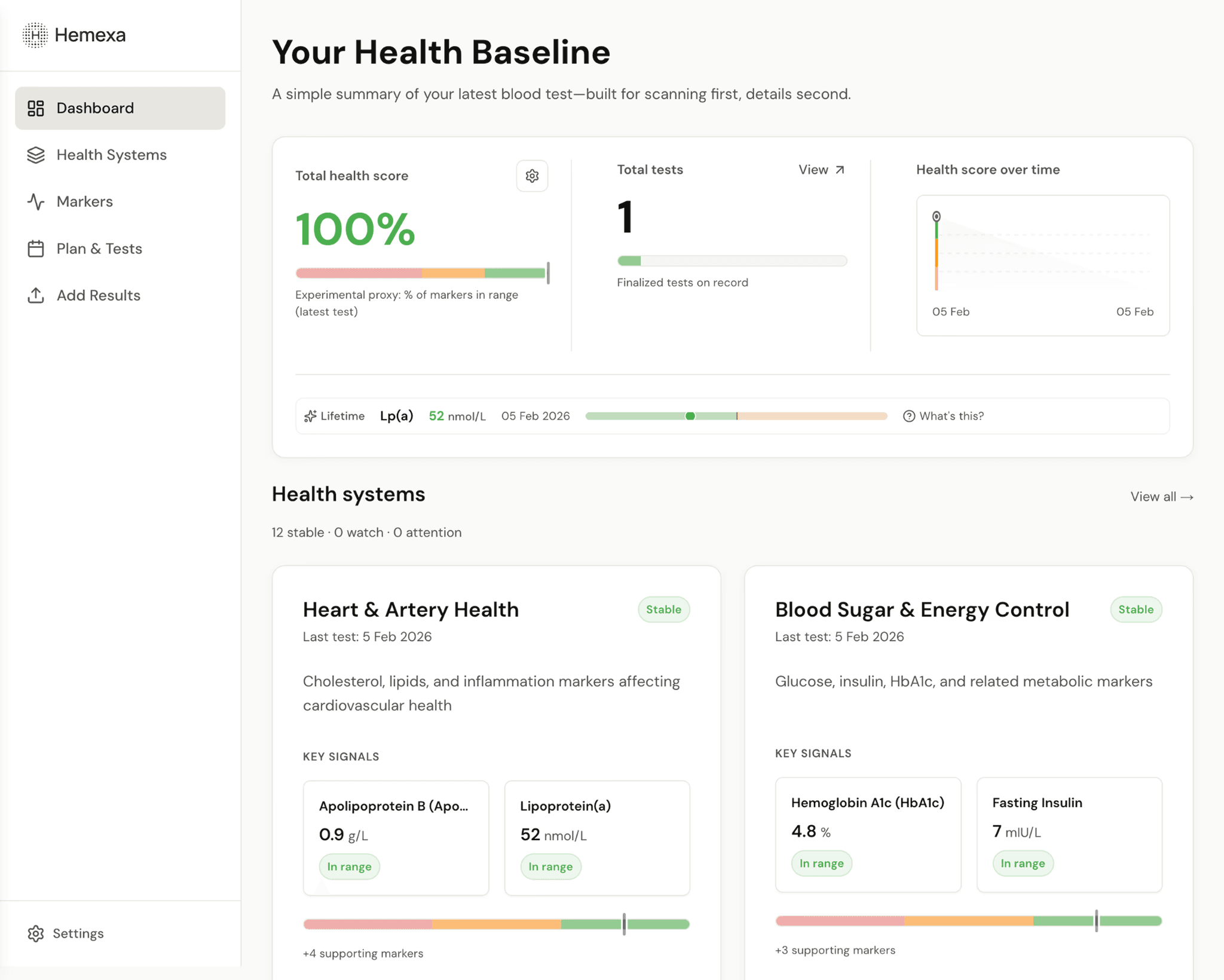
Hemexa includes fasting insulin on the annual signature panel with fasting glucose, HbA1c, and HOMA-IR. Results feed into blood sugar and energy control scores and trend lines after each structured retest.
Hemexa includes fasting insulin on the annual baseline panel as part of 77+ signature markers in the pancreatic function and glucose control category, alongside fasting glucose, HbA1c, and related metabolic markers.
When fasting glucose and fasting insulin are both present, Hemexa computes HOMA-IR and charts it over time so you can see insulin resistance trends without manual calculation.
Metabolic markers that move with lifestyle, including fasting insulin, are included on the six-month retest. Track whether insulin is trending down after diet, training, or weight changes.
Hemexa coordinates authorised pathology requests and nationwide collection through Laverty. Results feed into the blood sugar and energy control health-system score with per-marker trend lines.
Related guides: longevity blood test, ApoB test, and preventative blood test.
Start your membership in the member app. Or browse all 77+ markers before you decide.