
Genetic risk standard lipids miss
Roughly one in five people have elevated Lp(a). Many have normal LDL and no obvious risk factors until an event occurs. A single Lp(a) test can explain "unexpected" early heart disease in families.
Educational only; not medical advice
Lipoprotein(a), written Lp(a) and sometimes called "lipoprotein little a", is a cholesterol-carrying particle largely determined by your LPA gene. Blood levels are stable from early adulthood and rarely change with diet or exercise. An Lp(a) test measures that inherited cardiovascular risk. In Australia it is usually a private pathology add-on because Medicare rarely funds Lp(a) for routine screening in asymptomatic adults, yet guidelines increasingly recommend measuring it at least once in life.
Hemexa includes Lipoprotein(a) on the annual signature panel alongside ApoB, standard lipids, and hs-CRP. This guide explains what Lp(a) measures, why a one-time test matters, how to order it in Australia, and how to interpret results with your clinician.
Your annual baseline includes 77+ signature markers (77 for men, 81 for women), including 13 calculated insights from your lab results. Measured draws depend on sex (64–68). Fast-moving markers are tested again on your included six-month retest.
Standard lipid panels miss a major piece of cardiovascular risk. Lp(a) is an independent, genetically driven risk factor for heart attack, stroke, and aortic valve disease. Knowing your level helps you and your clinician interpret family history and plan prevention, even when LDL cholesterol looks fine.
Roughly one in five people have elevated Lp(a). Many have normal LDL and no obvious risk factors until an event occurs. A single Lp(a) test can explain "unexpected" early heart disease in families.
Lp(a) raises risk on its own. You can have low LDL and high Lp(a), or high LDL and low Lp(a). That is why preventative cardiologists pair Lp(a) with ApoB, LDL, and hs-CRP for a complete picture.
Lp(a) levels are set early and change little with age, diet, or most medications. International guidance supports measuring Lp(a) at least once in adulthood. Retesting is only needed if assay methods change or clinical guidelines recommend confirmation.
Australian GPs often order a standard lipid panel at a check-up. Lp(a) is a separate assay. Understanding how markers differ prevents false reassurance when LDL looks normal but inherited risk is high.
| Marker | What it measures | Medicare | Best for |
|---|---|---|---|
| LDL cholesterol (LDL-C) | Cholesterol mass inside LDL particles | Often funded when clinically indicated | Standard screening and statin monitoring |
| Apolipoprotein B (ApoB) | Total atherogenic lipoprotein particle count | Usually private out of pocket | Particle burden when LDL is borderline or discordant |
| Lipoprotein(a) (Lp(a)) | Genetically determined Lp(a) particle concentration | Usually private; one-time baseline often recommended | Family history of early heart disease, unclear lipid risk, aortic stenosis workup |
| hs-CRP | Low-grade systemic inflammation | Sometimes funded with cardiovascular risk assessment | Inflammatory component of residual risk |
Lp(a) is a standard NATA-accredited assay at major Australian pathology labs. The practical questions are Medicare billing, units on the report, and whether your panel includes it by default.
Medicare funds lipid panels when clinically necessary. Lp(a) for asymptomatic preventative screening is typically an out-of-pocket add-on, often $40 to $90 standalone or bundled in advanced heart health panels.
As with all pathology in Australia, Lp(a) needs an authorised request from a registered medical practitioner. Legitimate direct-to-consumer services include GP clinical review before the lab order is issued.
Australian labs increasingly report Lp(a) in nmol/L (particle number). Some still use mg/dL. Do not compare raw numbers across unit systems without conversion. Use the reference interval printed on your Australian lab report.
Lp(a) is not needed for everyone, but a one-time test is increasingly recommended when family history or unexplained cardiovascular risk suggests inherited lipid burden. Discuss with your GP or cardiologist.
Parents or siblings with heart attack, stroke, or sudden cardiac death before age 60, especially with "normal" cholesterol, is the classic indication for Lp(a) testing.
If you have had cardiovascular disease or aortic stenosis and standard lipids do not explain the risk, Lp(a) may be the missing inherited factor.
When LDL, ApoB, and lifestyle do not match perceived risk, a one-time Lp(a) test clarifies whether genetics are driving particle-related risk.
Elevated Lp(a) is linked to calcific aortic valve disease at younger ages. Cardiologists often check Lp(a) when stenosis appears earlier than expected.
Because Lp(a) only needs measuring once, many Australians include it in a first comprehensive preventative panel alongside ApoB, lipids, and hs-CRP.
Lp(a) stacks with LDL-driven risk in familial hypercholesterolaemia. Measuring both helps set targets and discuss intensified prevention.
From a Medicare lipid panel with a private add-on to a comprehensive membership that includes Lp(a) on the annual baseline. Costs and convenience vary.
| Approach | Best for | Typical cost | Lp(a) included? |
|---|---|---|---|
| GP lipid panel (Medicare) | Standard cardiovascular screening | Bulk-billed or low gap | Usually no; LDL, HDL, triglycerides only |
| GP-ordered Lp(a) add-on (private) | One-time inherited risk check when your doctor agrees | ~$40 to $90 out of pocket | Yes, as a single marker or small add-on panel |
| Pay-per-panel services (e.g. MediTests, i-screen) | One-off cardiovascular or comprehensive panels | ~$80 to $300+ depending on panel | Often included in advanced lipid or heart panels |
| Membership platforms (e.g. Hemexa) | Annual comprehensive panel with Lp(a) baseline stored in dashboard | ~$1,199/year (full membership) | Yes; Lp(a) on annual panel among 77+ signature markers |
Australian labs report Lp(a) with local reference ranges, usually in nmol/L. Interpretation should always involve your clinician. These are general reference points, not personal medical advice.
Many labs flag elevated Lp(a) above roughly 75 to 125 nmol/L, with higher risk often discussed above 125 nmol/L (about 50 mg/dL in older unit systems). Exact cut-offs vary by lab and guideline. Use the interval on your report.
Elevated Lp(a) raises lifetime cardiovascular and aortic stenosis risk but does not predict when an event will occur. Clinicians weigh Lp(a) alongside blood pressure, smoking, diabetes, LDL or ApoB, and family history.
Diet and exercise do not reliably lower Lp(a), but they reduce overall cardiovascular risk. Treating modifiable factors aggressively is standard when Lp(a) is high.
Lp(a)-lowering drugs (for example pelacarsen and olpasiran) are in clinical trials. PCSK9 inhibitors may lower Lp(a) modestly. Discuss options with a cardiologist or lipid clinic if your level is high and family history is strong.
Lp(a) is one of the least lifestyle-responsive lipid markers. Focus on what you can change for overall heart health, and use Lp(a) to personalise how aggressively you manage modifiable risk.
The LPA gene determines apolipoprotein(a) isoform size and plasma concentration. Levels are relatively stable from young adulthood through later life.
Mediterranean eating patterns and weight loss may lower Lp(a) slightly in some people, but not reliably enough to treat high Lp(a) with lifestyle alone.
Statins reduce LDL but typically do not correct high Lp(a). They remain important for overall LDL and ApoB control when those are also elevated.
Blood pressure, smoking cessation, glucose control, ApoB or LDL targets, and inflammation (hs-CRP) are the main levers when Lp(a) is high. Aggressive management of modifiable risk is the current standard of care.
Standard Medicare lipid panels omit Lp(a). Ask your GP or verify your private panel lists Lipoprotein(a).
Because Lp(a) is genetically stable, one well-documented result is usually enough for life. Store the PDF or dashboard record where future clinicians can find it.
Lp(a) explains inherited risk; ApoB and LDL show modifiable particle burden. A complete heart panel often includes all three plus hs-CRP.
Australian labs may report nmol/L or mg/dL. Compare your result only to the reference interval on that report, not to overseas cut-offs in a different unit.
If your Lp(a) is high, first-degree relatives may benefit from testing. Share your result with siblings and parents where appropriate.
Lp(a) can be drawn non-fasting. If combined with triglycerides or glucose on the same tube, follow fasting instructions on your lab slip.
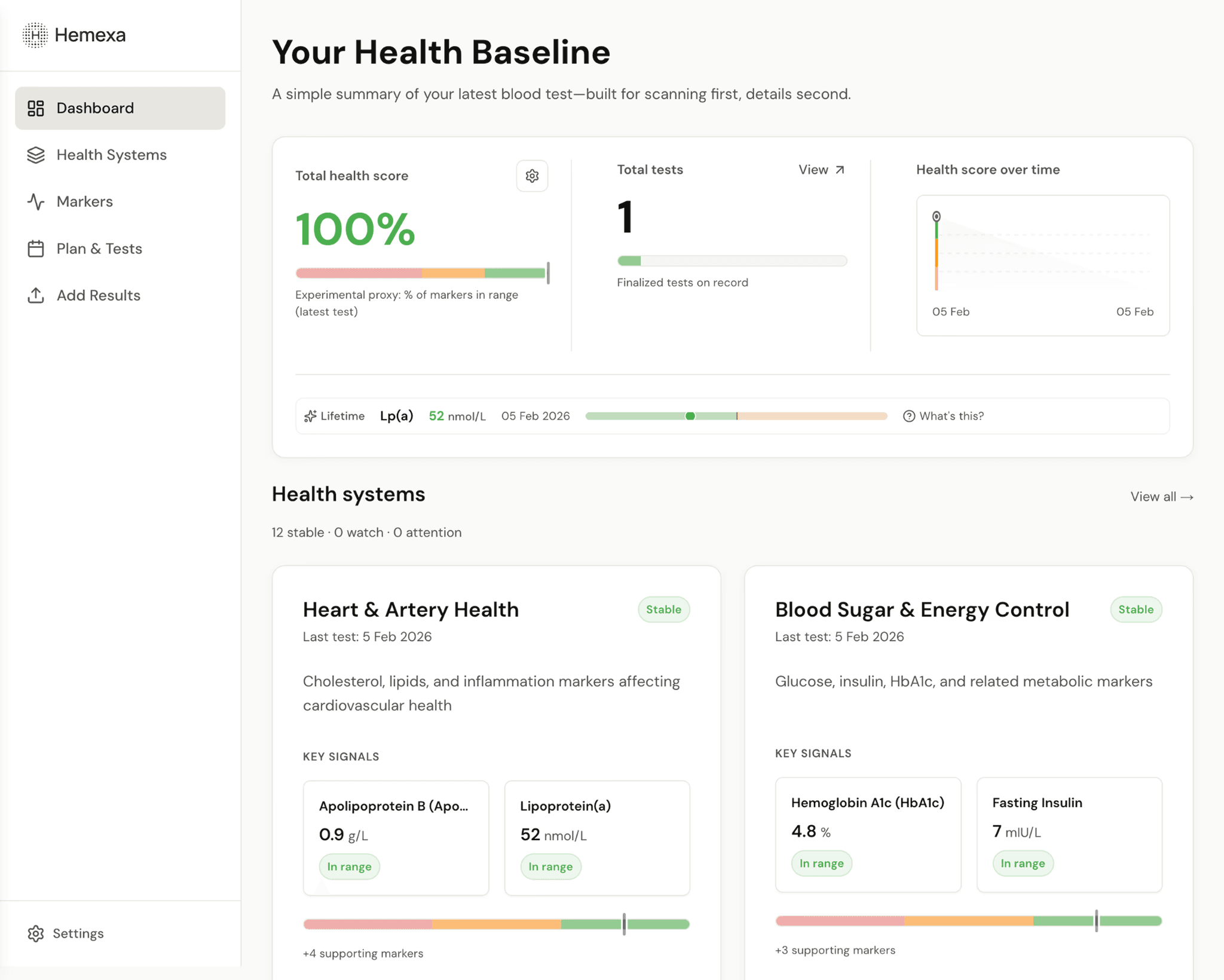
Hemexa includes Lipoprotein(a) on the annual signature panel with ApoB, standard lipids, and hs-CRP. Your Lp(a) baseline stays on the heart dashboard while modifiable markers trend on structured retests.
Hemexa includes Lipoprotein(a) on the annual baseline panel as part of 77+ signature markers across heart and circulation markers. You get Lp(a) with ApoB, LDL, HDL, triglycerides, and hs-CRP in one coordinated draw.
Lp(a) is genetically stable, so it is treated as a lifetime baseline marker rather than a six-month retest target. Your result stays on the heart dashboard for future clinical discussions.
Lp(a) appears alongside modifiable cardiovascular markers so you can see inherited risk in context with ApoB, lipids, and inflammation trends on structured retests.
Hemexa coordinates authorised pathology requests and nationwide collection through Laverty. No separate Lp(a) add-on shopping or ad-hoc lab orders.
Pair Lp(a) with particle-level testing in our ApoB test guide or read the preventative blood test guide.
Start your membership in the member app. Or browse all 77+ markers before you decide.