
Hemexa
Guide

Blood test tracker for Australia

A blood test tracker stores pathology results from multiple tests and shows how biomarkers change over time. In Australia, results usually arrive as PDFs from providers like Laverty, 4Cyte, Sullivan Nicolaides, Australian Clinical Labs, or QML. The right approach depends on whether you only need to log existing tests or want coordinated preventative panels with built-in retesting.

Hemexa is a membership platform for Australians who want coordinated preventative panels, an included six-month retest, and a health-system dashboard, not just PDF storage. This guide covers all three approaches so you can choose what fits.

Your annual baseline includes 60+ signature markers (exact count depends on sex; typically 59–63 measured). Fast-moving markers are tested again on your included six-month retest.

See all 60+ markers
Laverty collection nationwideIncluded six-month retestImport past pathology PDFs
Why it matters

Why track blood tests over time?

A single blood test is a snapshot. Tracking the same markers across months or years shows direction: whether lipids are improving, iron stores are recovering, or glucose markers are drifting.

Trends beat one-off numbers

Reference ranges tell you if a value is in range on one day. Trends tell you if it is moving the right way after lifestyle changes, supplements, or treatment.

Preventative testing is growing in Australia

More Australians order private panels beyond standard Medicare tests. Without a tracker, results pile up as PDFs in email or a folder with no easy way to compare year on year.

Your GP may not order everything you care about

Medicare-funded tests are symptom-driven. People tracking longevity, hormones, or nutrients often add private panels. A tracker keeps that history organised for discussions with your clinician.

Australian context

How blood testing works in Australia

Australian pathology is delivered through large networks. Results are NATA-accredited and usually include age- and sex-specific reference ranges aligned with RCPA guidance.

Medicare vs private panels

GP-ordered tests billed to Medicare cover standard screening when clinically indicated. Private preventative panels (ordered through a GP or direct-to-consumer services) cover broader biomarker sets you pay for out of pocket.

Major pathology providers

Laverty, 4Cyte Pathology, Sullivan Nicolaides Pathology, Australian Clinical Labs, and QML Pathology are among the networks Australians use most. Collection is often at a local centre; results arrive as PDF, sometimes with a portal link.

Typical turnaround

Most blood panels return within 24 to 72 hours. Complex hormone or specialty markers can take longer. Your tracker should store the collection date, not just when the PDF arrived.

Your options

Three ways Australians track blood tests

No single approach is right for everyone. Upload apps are excellent if you already have PDFs and want low-cost tracking. Membership platforms suit people who want testing and intelligence in one program.

ApproachBest forTypical costLimitations
Spreadsheet or manual notesOccasional tests, very few markersFreeTedious, error-prone, no insights, easy to lose history when you switch phones or email accounts
Upload-only apps (e.g. BloodTrack, BloodResults)Existing PDFs from any Australian lab; DIY trackingFree to ~$9/monthYou source and pay for every test yourself; no coordinated panel or included retest
Membership platforms (e.g. Hemexa, Vively, Everlab)Structured preventative program with dashboard and retesting~$799+/yearPaid membership; panels follow the provider program, not ad-hoc GP orders
Buying guide

What to look for in a blood test tracker

Parses Australian pathology PDFs

US-built apps often misread Sonic, Healius, or 4Cyte report layouts or default to US reference ranges. Confirm the tool supports your lab format.

Australian reference ranges by age and sex

RCPA-aligned ranges differ from US lab defaults. Tracking against the wrong range can misclassify a result as normal or abnormal.

Trend charts across multiple dates

You need the same marker plotted over time, not just a list of past PDFs. Look for line charts or tables that align units consistently.

Privacy and data hosting

Health data should be encrypted. Some Australians prefer providers that host data in Australia; check each product privacy policy.

Retest cadence

Annual testing misses mid-year shifts in fast-moving markers (glucose, lipids, inflammation). Six-month retesting is common in preventative memberships.

Structured panels vs ad-hoc markers

Upload apps accept any PDF. Membership platforms run defined panels so your dashboard compares apples to apples over time.

How Hemexa fits

Testing and tracking in one membership

Hemexa is not a free PDF upload tool. It coordinates GP-reviewed requests, Laverty collection, structured panels, and a dashboard that turns results into health-system scores, trends, and a personalised plan.

Coordinated baseline and six-month retest

Your membership includes a full annual panel and an included six-month retest on the markers that move fastest. 60+ signature markers on baseline; a small number are sex-specific.

Health-system dashboard and trends

Results roll into health-system scores (heart, metabolism, thyroid, hormones, nutrients, and more) with per-marker trend lines after each structured panel.

Personalised plan after every panel

Each test generates plain-language sections on what changed and what to discuss with your clinician, so tracking leads to action, not just storage.

Import past pathology after your baseline

After your first Hemexa panel, upload PDFs from other Australian providers into your timeline. Deeper dashboard integration for imported results is coming soon.
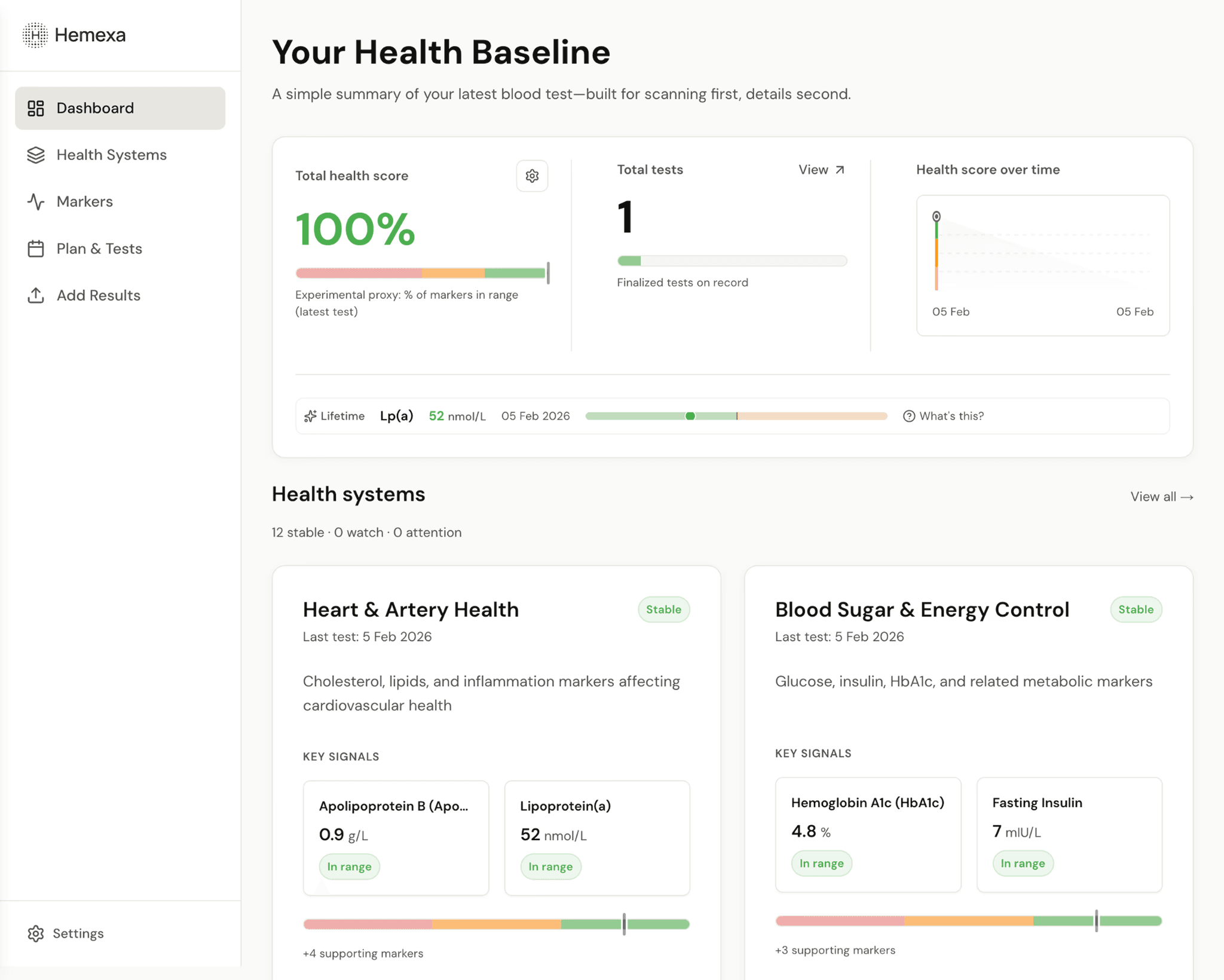
Explore the demo →
Hemexa dashboard showing health systems, scores, and biomarker trends
Decision helper

Upload app or membership?

Choose an upload-only app if

  • You already have GP-ordered tests and only want free or low-cost tracking
  • You test rarely and do not need a structured preventative panel
  • You are comfortable sourcing and paying for each panel yourself

Choose Hemexa membership if

  • You want a comprehensive preventative panel with an included six-month retest
  • You want health-system scores, a personalised plan, and supplement insights tied to your blood
  • You want one membership that coordinates GP-reviewed requests and Laverty collection nationwide
FAQ

Common questions about blood test tracking in Australia

What is the best blood test tracker in Australia?
It depends on your goal. Upload-only apps like BloodTrack or BloodResults suit Australians who already have PDFs from Laverty, 4Cyte, or similar labs and want free or low-cost trend charts. Membership platforms like Hemexa suit people who want coordinated preventative panels, included retesting, and a health-system dashboard. Spreadsheets work for occasional tests but do not scale.
How do I track blood test results from Laverty or 4Cyte?
Download the PDF from your email or pathology portal, then upload it to a tracker app or store values manually. Upload apps parse Australian report formats automatically. Hemexa members can add past PDFs to their timeline after completing a baseline panel.
Is there a free blood test tracker for Australia?
Yes. Several web apps offer free tiers for uploading Australian pathology PDFs and viewing basic trends. They do not include coordinated blood testing or GP-reviewed requests. Hemexa is a paid membership (AU$799/year) that includes testing, retesting, and dashboard intelligence.
How often should I retest blood markers?
Annual testing is a common minimum for preventative panels. Markers that move quickly (glucose, lipids, some hormones) benefit from a six-month check. Hemexa includes a six-month retest in membership. Your doctor may recommend a different cadence based on your health.
Can I import old blood tests into Hemexa?
Yes, after your first Hemexa baseline panel you can upload pathology PDFs from other Australian providers into your timeline. Imported results are viewable alongside structured Hemexa panels; deeper dashboard integration is coming soon.
What is the difference between a blood test tracker and a health testing membership?
A tracker stores and charts results you already have. A membership coordinates testing (GP-reviewed requests, collection network, defined panels), includes retesting, and turns results into dashboard scores, plans, and insights. Hemexa is a membership; upload apps are trackers.
Does Hemexa replace my doctor?
No. Hemexa organises pathology, trends, and discussion-ready summaries. Results are reviewed by a registered Australian GP as part of the testing workflow. Diagnosis and treatment decisions stay with you and your clinician.
What biomarkers should I track over time?
Common preventative sets include metabolic markers (glucose, HbA1c, lipids, insulin), liver and kidney function, thyroid, iron, vitamins, and sex hormones where relevant. Hemexa baseline covers 60+ signature markers across 16 health-system categories. Your doctor can prioritise markers for your situation.
What pathology providers does Hemexa use?
Hemexa coordinates collection through the Laverty Pathology network across Australia. After your baseline, you can import PDFs from other major Australian providers into your member timeline.
More guides

Testing guide

Biomarker testing Australia

How biomarker testing works in Australia: Medicare vs private panels, common marker categories, pathology networks, and membership options with retesting.

Read guide →

Testing guide

Preventative blood test Australia

How preventative blood testing works in Australia: Medicare vs private panels, what markers to include, costs, GP-reviewed requests, and retest cadence.

Read guide →

Longevity guide

Longevity blood test Australia

What longevity blood tests measure, which biomarkers to include, how Australian options compare to Function Health, and how to choose a panel or membership.

Read guide →

Biomarker guide

ApoB test Australia

What Apolipoprotein B measures, ApoB vs LDL cholesterol, typical costs and Medicare coverage in Australia, reference ranges, and how to order through a GP or private panel.

Read guide →

Biomarker guide

Lipoprotein(a) test Australia

What Lp(a) measures, why it is a genetically determined cardiovascular risk factor, typical costs and Medicare coverage in Australia, reference ranges in nmol/L, and one-time testing guidance.

Read guide →

Biomarker guide

Fasting insulin test Australia

Fasting insulin testing in Australia: insulin resistance screening, reference ranges, HOMA-IR, Medicare vs private costs, fasting requirements, and how to order.

Read guide →

Biomarker guide

HOMA-IR Australia

What HOMA-IR measures, how it is calculated from fasting glucose and insulin, optimal ranges, Medicare vs private testing, and how to track insulin resistance over time.

Read guide →

Biomarker guide

Vitamin D blood test Australia

25-hydroxyvitamin D testing in Australia: deficiency ranges in nmol/L, Medicare vs private costs, when to test, supplementation, and how to order.

Read guide →

Biomarker guide

hs-CRP test Australia

High-sensitivity CRP testing in Australia: inflammation and cardiovascular risk, hs-CRP vs standard CRP, typical costs, Medicare coverage, reference ranges in mg/L, and when to retest.

Read guide →

Biomarker guide

Testosterone blood test Australia

Testosterone blood testing in Australia: total vs free testosterone, SHBG, morning collection, reference ranges in nmol/L, Medicare vs private costs, TRT monitoring, and how to order.

Read guide →

Biomarker guide

Thyroid blood test Australia

What TSH, free T4, and free T3 measure, typical costs and Medicare coverage in Australia, reference ranges, antibody testing, and how to order through a GP or private panel.

Read guide →

View all guides

Ready for more than storing PDFs?

Claim a founding spot and we will send next steps when onboarding opens. Or browse all 60+ signature markers before you decide.

All guides