
Detects insulin resistance early
Fasting insulin often rises 10 to 20 years before HbA1c crosses into prediabetes. HOMA-IR combines glucose and insulin into one number that reflects how hard your pancreas is working to keep blood sugar stable.
Educational only; not medical advice
HOMA-IR (Homeostatic Model Assessment of Insulin Resistance) is a calculated index that estimates how resistant your cells are to insulin. Australian labs derive it from fasting glucose and fasting insulin using the formula (glucose mmol/L × insulin mIU/L) ÷ 22.5. It often appears on private metabolic panels before HbA1c or fasting glucose look abnormal, making it one of the earliest practical markers of metabolic dysfunction.
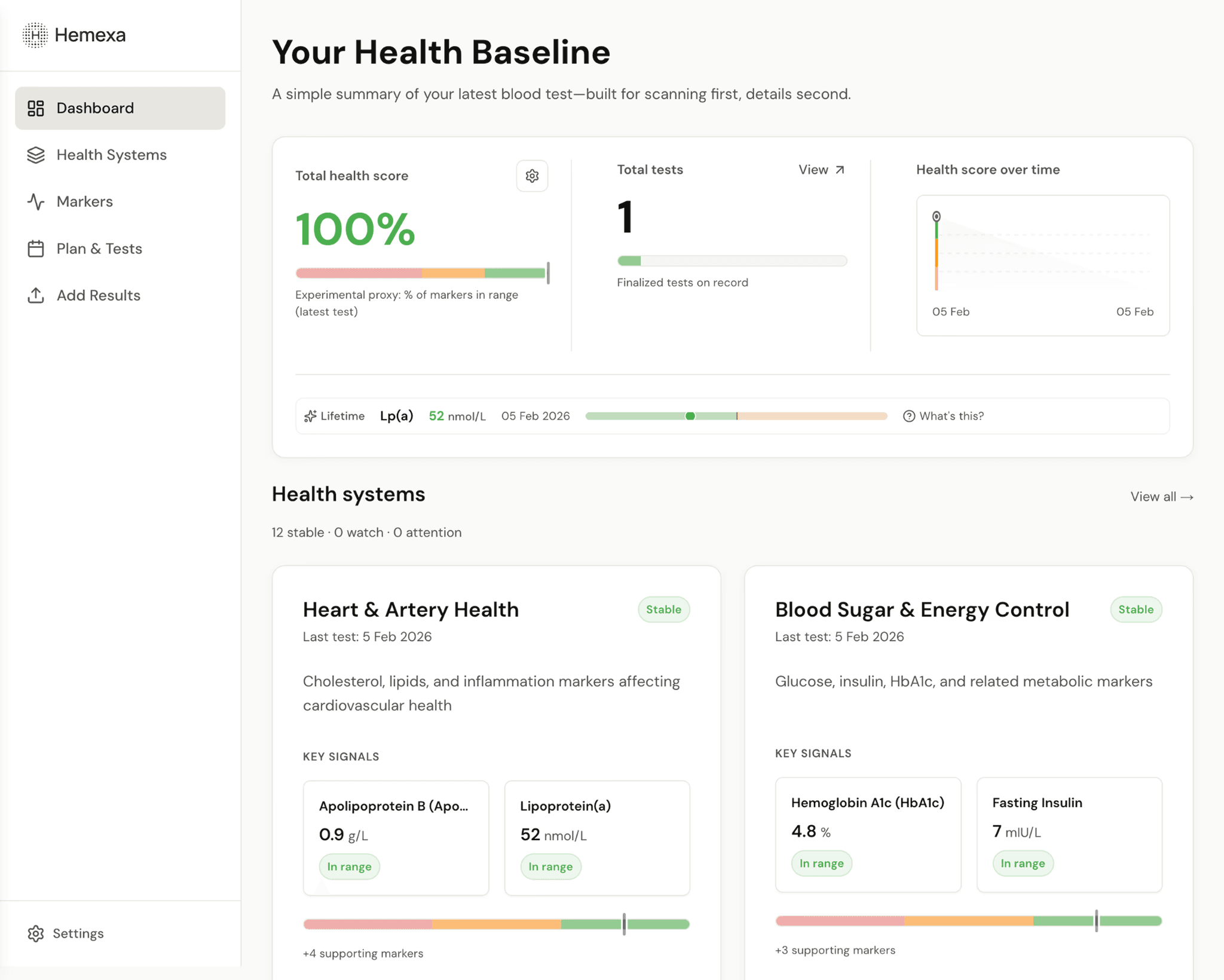
Hemexa calculates HOMA-IR automatically from fasting glucose and fasting insulin on the annual panel, with retest and trend tracking on the blood sugar and energy dashboard. This guide explains how HOMA-IR works in Australia so you can order the right tests and interpret results.
Your annual baseline includes 77+ signature markers (77 for men, 81 for women), including 13 calculated insights from your lab results. Measured draws depend on sex (64–68). Fast-moving markers are tested again on your included six-month retest.
Standard GP checks often stop at fasting glucose and HbA1c. Both can stay normal for years while insulin rises to compensate. HOMA-IR captures that hidden phase of insulin resistance, when lifestyle changes still have the biggest impact.
Fasting insulin often rises 10 to 20 years before HbA1c crosses into prediabetes. HOMA-IR combines glucose and insulin into one number that reflects how hard your pancreas is working to keep blood sugar stable.
Two people can share the same fasting glucose but have very different insulin levels and metabolic risk. HOMA-IR distinguishes compensated hyperinsulinemia from genuinely healthy metabolism.
Elevated HOMA-IR responds to weight loss, resistance training, sleep, and carbohydrate quality. Tracking it over retests shows whether those changes are working, often within 8 to 12 weeks.
HOMA-IR uses the Matthews et al. (1985) formula with Australian-standard units. If your results use different units, conversion is required before calculating.
HOMA-IR = (Fasting Glucose mmol/L × Fasting Insulin mIU/L) ÷ 22.5
Example: fasting glucose 5.2 mmol/L and fasting insulin 12 mIU/L gives HOMA-IR = (5.2 × 12) ÷ 22.5 ≈ 2.77. In preventative framing this is borderline to elevated; clinical significance depends on your full metabolic picture and whether HOMA-IR exceeds standard thresholds (often above 2.5 to 3.0).
Each metabolic marker tells a different part of the story. HOMA-IR is not a standalone blood test at most Australian labs; it is calculated once fasting glucose and fasting insulin are available.
| Marker | What it measures | Medicare | Best for |
|---|---|---|---|
| Fasting glucose | Blood sugar after an overnight fast | Often funded when clinically indicated | Diabetes screening and standard GP checks |
| HbA1c | Average blood glucose over roughly three months | Often funded for diabetes monitoring | Established dysglycaemia and diabetes follow-up |
| Fasting insulin | Pancreatic insulin output after fasting | Usually private out of pocket | Seeing hyperinsulinemia before glucose rises |
| HOMA-IR (calculated) | Estimated insulin resistance from glucose × insulin | Not billed separately; needs private insulin test | Single index for insulin resistance and metabolic risk |
HOMA-IR is not a separate Medicare item. You need fasting glucose and fasting insulin on the same blood draw, then the index is calculated by the lab or your results platform.
Medicare funds fasting glucose and HbA1c when clinically necessary. Fasting insulin for asymptomatic screening is typically an out-of-pocket add-on, often $30 to $80. HOMA-IR follows from those two results.
Some Australian pathology providers report HOMA-IR directly when both inputs are on the request. Others return glucose and insulin only; platforms like Hemexa calculate HOMA-IR automatically from paired results.
Both inputs must come from the same fasting draw (8 to 12 hours, water only). Non-fasting insulin invalidates HOMA-IR. Morning collection is standard because cortisol and circadian rhythm affect insulin.
Because HOMA-IR depends on fasting insulin, the path you choose determines whether you get a one-off calculation or longitudinal tracking with retests.
| Approach | Best for | Typical cost | Includes HOMA-IR |
|---|---|---|---|
| GP metabolic screen (Medicare) | Standard diabetes screening | Bulk-billed or low gap | Usually no; glucose and HbA1c only, no fasting insulin |
| GP-ordered fasting insulin add-on (private) | One-off HOMA-IR when your doctor agrees | ~$30 to $80 for insulin plus glucose | Yes, if lab calculates or you compute from results |
| Pay-per-panel metabolic tests (e.g. MediTests, i-screen) | Comprehensive metabolic or longevity panels | ~$80 to $300+ depending on panel | Often included when fasting insulin is on the panel |
| Membership platforms (e.g. Hemexa) | Annual HOMA-IR baseline with retest and trend tracking | ~$1,199/year (full membership) | Yes; calculated from fasting glucose and insulin on 77+ signature markers |
HOMA-IR is unitless. The cut-offs below reflect preventative and longevity-medicine thresholds, not standard clinical diagnostic criteria. Standard clinical and epidemiological insulin resistance is typically defined as HOMA-IR above 2.5 to 3.0, though cut-offs vary by guideline. Interpretation always belongs with your clinician. These are general reference points, not personal medical advice.
Many longevity-focused references use below 1.0 as optimal, 1.0 to 1.9 as early insulin resistance, 2.0 to 2.5 as borderline in preventative framing, and above 2.5 to 3.0 as more consistent with clinical insulin resistance. A value around 2.0 to 2.3 in an otherwise healthy person may not be clinically concerning on its own. Population lab ranges may be wider.
HOMA-IR rises with visceral fat, sedentary habits, poor sleep, and some medications. It falls with weight loss, resistance training, and improved insulin sensitivity. Compare against your own trend, not a single threshold.
HOMA-IR, HbA1c, triglycerides, HDL, and waist circumference together describe metabolic health. Elevated HOMA-IR with normal HbA1c still warrants lifestyle focus and follow-up.
Lifestyle and metformin-class changes can shift HOMA-IR within 8 to 12 weeks. Annual testing with a six-month check after meaningful changes is common in preventative programs.
Family history of type 2 diabetes, central adiposity, fatty liver, PCOS, or borderline lipids with normal HbA1c. HOMA-IR often flags insulin resistance first.
If HbA1c or waist circumference is already borderline, HOMA-IR quantifies insulin resistance and helps track response to diet and exercise.
Preventative medicine increasingly treats insulin sensitivity as a core longevity lever. HOMA-IR is a standard marker in comprehensive metabolic panels.
Reactive hypoglycaemia, afternoon fatigue, and difficulty losing weight despite calorie restriction can correlate with high fasting insulin and HOMA-IR.
Hormonal transitions affect insulin sensitivity. A baseline HOMA-IR helps separate normal fluctuation from emerging metabolic dysfunction.
If you changed diet, training, or sleep specifically for metabolic health, HOMA-IR on a six-month retest confirms whether insulin sensitivity improved.
HOMA-IR responds to modifiable factors. These are levers clinicians discuss after results, not substitutes for personalised medical advice.
Losing excess abdominal fat is one of the most reliable ways to lower fasting insulin and HOMA-IR. Even 5 to 10% weight loss can produce measurable improvement.
Muscle is the main site of glucose disposal. Regular resistance training and post-meal walking improve insulin sensitivity within weeks.
Refined carbohydrates and frequent snacking keep insulin elevated. Lower-glycaemic patterns, adequate protein, and consistent meal timing often lower HOMA-IR over 8 to 12 weeks.
Short sleep and chronic stress raise cortisol and insulin. Fixing sleep duration and stress load is an underused lever for HOMA-IR improvement.
HOMA-IR requires both markers from the same draw. Confirm both are on the pathology request; glucose alone is not enough.
Water only unless your clinician advises otherwise. Food, coffee with milk, or alcohol before the draw can falsely elevate insulin.
Insulin follows a diurnal rhythm. Australian labs recommend morning fasting collection for comparable results over time.
Some labs calculate it automatically. If not, use the mmol/L and mIU/L formula or a platform that derives it from paired results.
Metabolic risk is multidimensional. Pair HOMA-IR with HbA1c, triglycerides, HDL, and optionally ApoB for a complete picture.
A single HOMA-IR is a snapshot. Annual testing with a six-month follow-up after lifestyle or medication changes shows whether insulin sensitivity is improving.
Hemexa includes fasting glucose and fasting insulin on structured panels, calculates HOMA-IR automatically, and tracks it in the blood sugar and energy health-system dashboard.
Hemexa includes fasting glucose and fasting insulin on the annual baseline panel as part of 77+ signature markers. HOMA-IR is calculated automatically when both results are available.
Metabolic markers that move with lifestyle are included on the six-month retest. Track whether HOMA-IR is trending down after diet, training, or sleep changes.
HOMA-IR feeds into the blood sugar and energy health-system score on the Hemexa dashboard, alongside HbA1c, glucose, and insulin trend lines.
Hemexa coordinates authorised pathology requests and nationwide collection through Laverty. No separate insulin add-on shopping or manual HOMA-IR spreadsheets.
HOMA-IR needs fasting insulin on the same draw. Read our fasting insulin test guide, or see the preventative blood test guide for the full metabolic panel.
Start your membership in the member app. Or browse all 77+ markers before you decide.